EN
EN


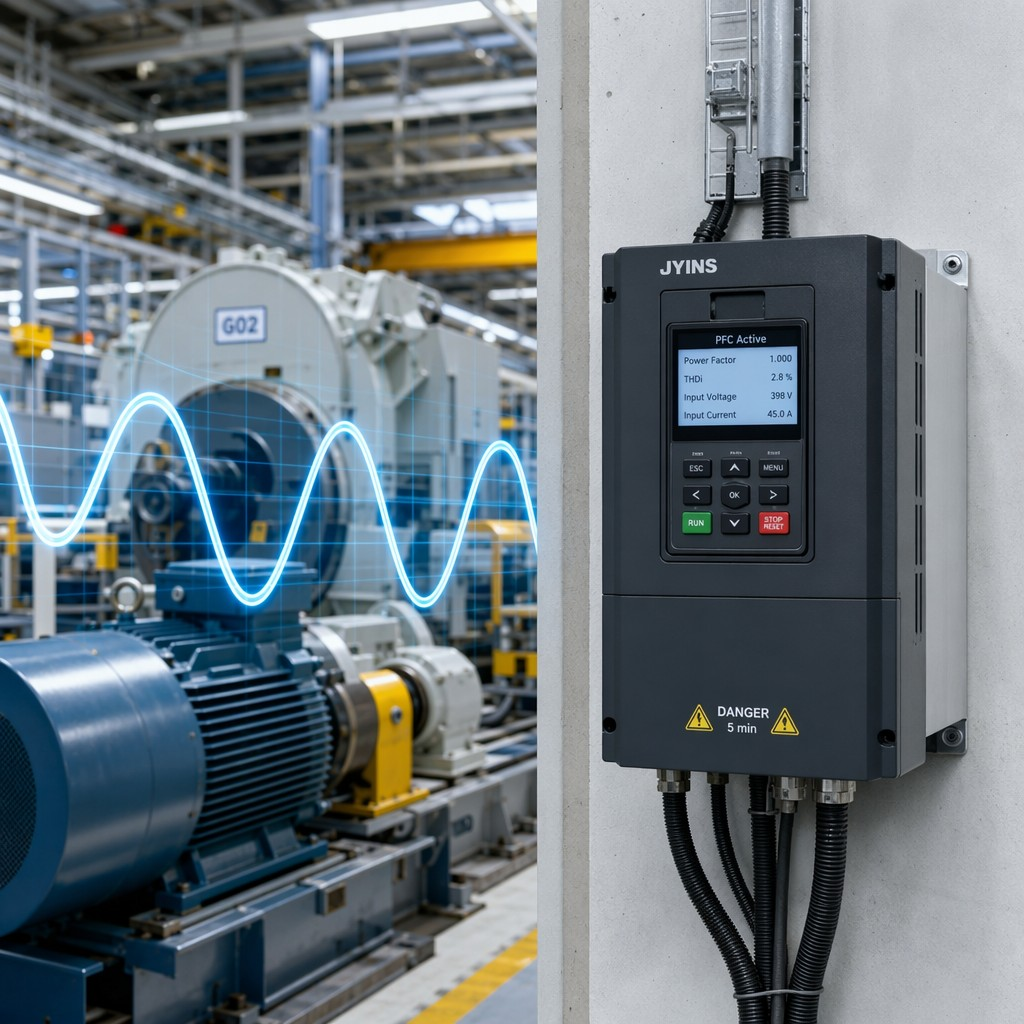
Q: Why Is Active Power Factor Correction (PFC) in JYINS Industrial-Grade Inverters Critical to Reducing THD for Motor-Driven Machinery?
A:
In the B2B industrial manufacturing sector, motor-driven equipment (such as air compressors, water pumps, CNC machine tools, and conveyor belts) is the heart of the production line. However, these inductive loads and VFD-equipped loads often have a low power factor and feed significant harmonic pollution back into the supply system, that is, total harmonic distortion (THD). If the inverter cannot properly handle these power quality issues, not only does its own efficiency drop, but motors overheat, bearings are damaged, and even precision instruments throughout the plant can malfunction. JYINS industrial-grade inverters solve this challenge at the source with integrated active power factor correction (Active PFC) technology. This article reveals how PFC is the key to reducing THD and optimizing industrial power consumption.
1. The Core Pain Point: Electrical Pollution from Inductive Loads
In industrial power environments, traditional induction motors require a large amount of reactive power during starting and running to build their magnetic fields. This leads to two serious consequences:
- Low power factor (PF): The current phase lags the voltage phase. This means the inverter must deliver more current than the actual work performed, adding burden to cables and transformers and exposing the plant to utility penalty charges.
- Elevated THD: Modern industrial motors are usually paired with nonlinear switch-mode power supplies or variable frequency drives (VFDs), which draw non-sinusoidal current. This current distortion generates high-order harmonics that pollute the entire internal power network, causing voltage waveform peak clipping or glitches.
2. What Is JYINS Active PFC Technology?
Traditional power factor correction relies on passive components (such as capacitor banks), but these respond slowly and are prone to resonance with loads. By contrast, the active PFC (APFC) used in JYINS inverters is an advanced power electronics technology:
- Technical logic: Before the inverter DC-AC conversion stage, or within the AC-side control logic, high-speed switching devices (such as IGBTs) and a dedicated PFC controller force the current waveform to track the phase and shape of the voltage waveform.
- Achieved effect: APFC raises the power factor above 0.99 while keeping the current THD within an extremely low 3% - 5% range (at rated load).
3. Three Major Technical Advantages of Active PFC in THD Reduction
For B2B customers, the PFC function of JYINS inverters is not just a technical specification. It is a powerful tool for energy saving and emission reduction.
3.1 Suppress Waveform Distortion and Protect Precision Bearings
High THD means the current contains a large amount of high-frequency content. For motors, these high-frequency harmonics create additional eddy current losses between the rotor and stator, causing abnormal motor heating and possibly generating electric discharge currents (fluting) on the bearings that shorten motor life. JYINS outputs a near-perfect sinusoidal current through PFC technology, ensuring smooth operation of motor-driven machinery and significantly reducing the risk of unplanned downtime.
3.2 Optimize Transformer and Cable Capacity Utilization
Harmonic currents do no useful work, but they increase the RMS current in cables. This causes abnormal heating due to the skin effect. JYINS active PFC reduces the reactive current component, allowing B2B customers to add more loads without upgrading to thicker cables, directly saving infrastructure investment costs.
3.3 Prevent Mutual Interference with Other Equipment in the System
In a shared industrial power network, if a large compressor generates severe THD, nearby PLC controllers or high-precision sensors may malfunction. As the core filter of the power supply, the PFC function of JYINS industrial-grade inverters ensures clean output, providing a power environment with good electromagnetic compatibility (EMC) for the entire plant.
4. In-Depth Analysis of Industrial Application Scenarios
- Scenario A: Off-grid mining sites and oil fields
In environments without utility power support, JYINS inverters must independently drive heavy drilling rigs. Active PFC ensures that during heavy-load startup, the inverter does not collapse from excessive reactive power impact, safeguarding operational continuity.
- Scenario B: Food processing plants
Numerous refrigeration compressors that start and stop frequently generate severe voltage fluctuations. JYINS fast-response PFC algorithm adjusts current compensation within milliseconds, maintaining voltage stability and preventing cold chain interruptions.
5. Engineer Selection Guide: How to Evaluate PFC Performance
When evaluating B2B suppliers, engineers should focus on the following three key indicators:
- Full-load PF value: Can it reach around 0.99?
- Light-load THD suppression: Many ordinary inverters see THD spike sharply at half load, while JYINS optimizes PFC performance across the entire power range.
- Dynamic response time: When loads change abruptly, can the PFC loop converge quickly?
6. Conclusion
For B2B industrial buyers, an inverter is more than just an energy conversion device. It is a power quality manager. The integrated active power factor correction technology in JYINS industrial-grade inverters systematically reduces THD and improves PF, providing the ideal operating environment for motor-driven machinery. This not only improves energy utilization, but also significantly reduces the total cost of ownership (TCO) of industrial equipment. In today pursuit of efficient, intelligent manufacturing, choosing a JYINS solution with active PFC technology is a smart decision for every business that values stable production.
Table of Contents
- Q: Why Is Active Power Factor Correction (PFC) in JYINS Industrial-Grade Inverters Critical to Reducing THD for Motor-Driven Machinery?
- A:
- 1. The Core Pain Point: Electrical Pollution from Inductive Loads
- 2. What Is JYINS Active PFC Technology?
- 3. Three Major Technical Advantages of Active PFC in THD Reduction
- 3.1 Suppress Waveform Distortion and Protect Precision Bearings
- 3.2 Optimize Transformer and Cable Capacity Utilization
- 3.3 Prevent Mutual Interference with Other Equipment in the System
- 4. In-Depth Analysis of Industrial Application Scenarios
- 5. Engineer Selection Guide: How to Evaluate PFC Performance
- 6. Conclusion