EN
EN


Q: How do you troubleshoot phase-locked loop (PLL) synchronization errors in unstable or weak rural microgrids?
A:
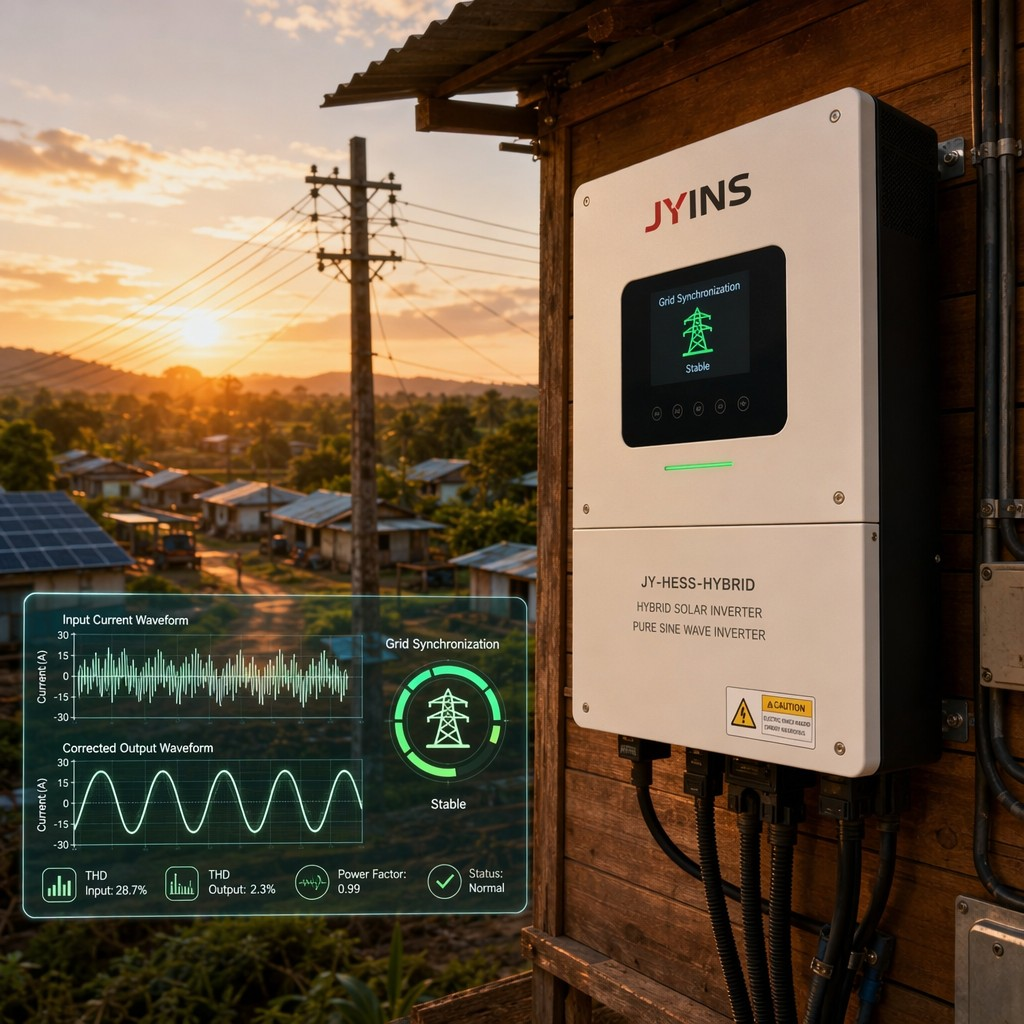
In many remote rural areas or emerging-market microgrid projects, grid quality is often extremely poor. These grids are commonly referred to as "weak grids," characterized by low short-circuit capacity, high impedance, severe voltage fluctuations, and frequent frequency drift. For a grid-tied inverter to operate stably in this environment, its core component — the phase-locked loop (PLL) — faces a serious challenge. If the PLL cannot track the grid phase accurately, the inverter will repeatedly lose synchronization and drop off-grid. The JYINS expert team has consolidated a professional workflow, from algorithm tuning to on-site troubleshooting, specifically for rural microgrid scenarios, to resolve PLL synchronization issues.
1. Core Concepts: Why Does the PLL "Get Lost" in Rural Grids?
The phase-locked loop (PLL) is the "eye" of a grid-tied inverter. Its job is to continuously monitor the phase and frequency of the grid voltage, ensuring that the inverter's output current waveform is perfectly synchronized with the grid voltage. In an ideal urban grid, the voltage waveform is a clean sine wave that the PLL can lock onto easily. In rural microgrids, however, the following disturbances come into play:
- Voltage distortion and harmonics: The operation of large agricultural machinery or welding machines generates severe nonlinear interference, causing glitches and phase jumps in the voltage waveform.
- Low short-circuit ratio (SCR): When the inverter's power output approaches the local grid's capacity, the current injected by the inverter can significantly affect the grid voltage phase in return, creating an unstable positive-feedback loop.
- Severe frequency fluctuation: If the microgrid is supported by small generators or micro-hydro units, its frequency stability is extremely poor. A PLL that is not responsive enough will accumulate phase errors over time.
2. JYINS Inverters' Immunity-Enhanced PLL Technology
To maintain synchronization under extreme conditions, JYINS industrial-grade inverters integrate several core algorithms in their digital signal processor (DSP):
- Second-order generalized integrator PLL (SOGI-PLL): Compared with the conventional synchronous reference frame PLL (SRF-PLL), the SOGI-PLL offers stronger filtering capability. It can filter out background harmonics introduced by long-distance transmission lines and extract only the fundamental frequency, keeping the PLL locked even under severe voltage distortion.
- Frequency-adaptive mechanism: The JYINS PLL features an extremely wide frequency tracking range (e.g., 45Hz to 65Hz) and adjusts its loop bandwidth in real time based on the rate of change of frequency (df/dt). When frequency drifts rapidly, it can switch quickly from "precise tracking mode" to "stable following mode."
- Weak-grid auxiliary control algorithm: In low-SCR environments, the inverter automatically increases the damping factor to prevent resonance between the inverter control system and the grid impedance.
3. On-Site Steps to Troubleshoot PLL Synchronization Errors
If your JYINS inverter reports "Grid Lost" or "Sync Error" on site, follow these steps:
3.1 Monitor Grid Impedance and Voltage Drop
Measure the voltage difference at the inverter's output terminals under loaded and unloaded conditions. If the voltage drop exceeds 10%, the feeder cable is too thin or the transformer capacity is insufficient. This high-impedance environment is the physical root cause of PLL instability. It is recommended to shorten the wiring distance or increase the cable cross-section.
3.2 Adjust the Inverter's Grid Connection Window Parameters
In the JYINS engineer portal (via the monitoring app or LCD settings), appropriately relax the over-voltage upper limit and frequency protection thresholds. In rural areas, local standards are often more lenient than urban ones; moderately widening these ranges can effectively reduce grid disconnections caused by momentary transients.
3.3 Enable Low-Voltage Ride-Through (LVRT)
In weak grids, momentary voltage sags are very common. With LVRT enabled, the inverter does not immediately cut output when the voltage dips briefly; instead, it supports the grid voltage by providing reactive power, giving the PLL time to recover and re-lock.
3.4 Diagnose Harmonic Sources
Use a handheld oscilloscope to check for high-frequency interference on the grid side. If harmonic interference is found in a specific frequency band, install a small passive filter or ferrite beads on the inverter's AC side to physically protect the PLL sampling circuit from high-frequency noise.
4. Long-Term Recommendations for B2B Projects
- Upfront assessment: Before bidding on a rural microgrid B2B project, always request the local grid's short-circuit capacity data. If the SCR is below 3, you must select a JYINS inverter equipped with dedicated weak-grid firmware.
- Staggered start-up strategy: If a site deploys multiple inverters, configure different grid-connection delay times in the backend so that not all inverters connect to the grid simultaneously — a simultaneous connection could shock the weak grid and cause all PLLs to fail synchronization.
- Hybrid energy storage backup: In extremely unstable rural grids, the JYINS hybrid inverter solution is recommended. If the PLL is unable to lock onto the grid for longer than a set period due to poor grid quality, the inverter automatically switches to off-grid mode to prioritize critical loads.
5. Conclusion
Resolving PLL synchronization errors in rural microgrids requires both advanced digital filtering algorithms inside the inverter and a deep understanding of weak-grid characteristics on the part of field engineers. Through its deeply optimized SOGI-PLL technology and flexible parameter settings, JYINS delivers a stable and reliable power supply for remote areas. For B2B partners, mastering these technical details not only reduces on-site maintenance frequency but also delivers tangible energy gains for end users.
Table of Contents
- Q: How do you troubleshoot phase-locked loop (PLL) synchronization errors in unstable or weak rural microgrids?
- A:
- 1. Core Concepts: Why Does the PLL "Get Lost" in Rural Grids?
- 2. JYINS Inverters' Immunity-Enhanced PLL Technology
- 3. On-Site Steps to Troubleshoot PLL Synchronization Errors
- 4. Long-Term Recommendations for B2B Projects
- 5. Conclusion