EN
EN


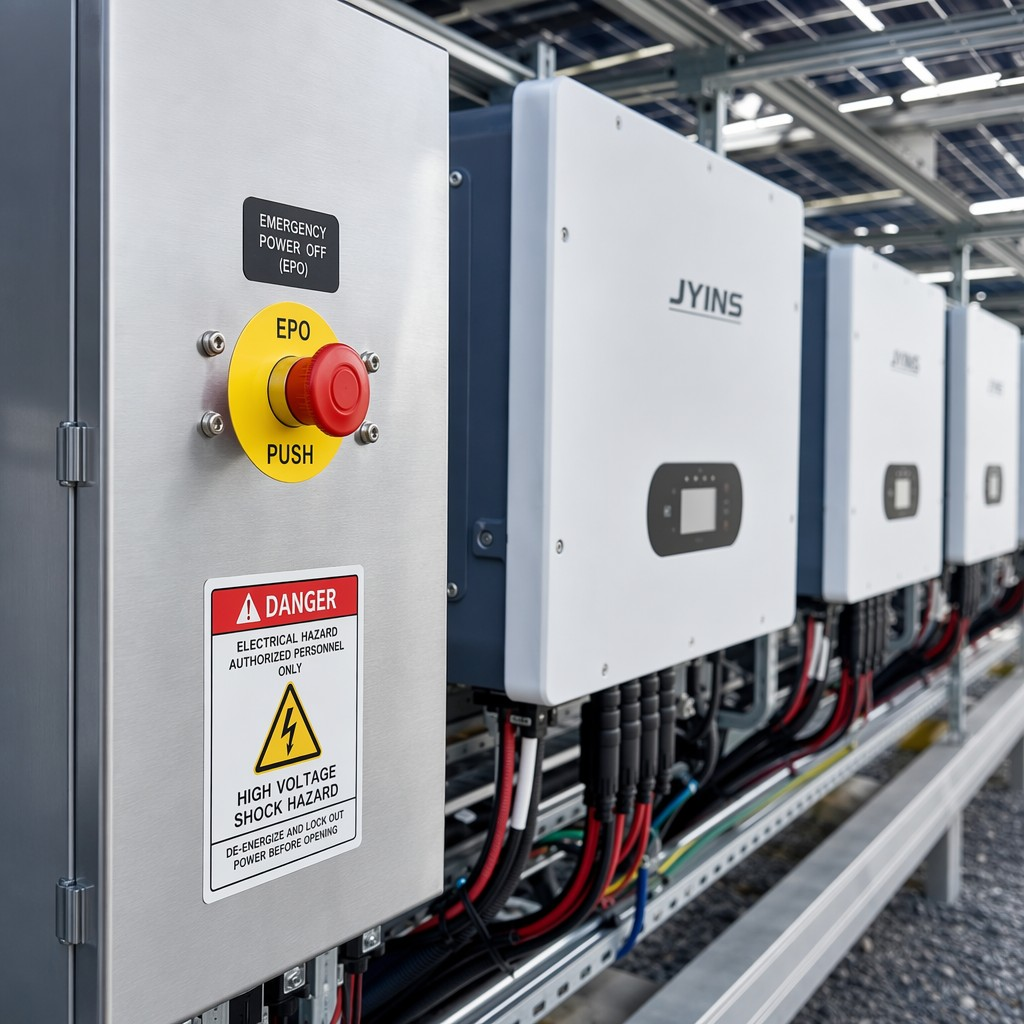
Q: How to Design a Fail-Safe Remote Emergency Power Off (EPO) Interface for B2B Commercial PV Installations?
A:
In commercial and industrial (C&I) scale PV installations, safety comes first. Whether for sudden fire emergencies, equipment maintenance, or compliance with local fire codes (such as NEC 690.12 or the relevant IEC standards), a reliable remote emergency power off (EPO) system is essential. However, many novice installers overlook the fail-safe logic design. As an industrial-grade inverter solutions provider, JYINS understands the critical importance of instant response in extreme environments. This article details how to design a highly reliable EPO system using the built-in interface of JYINS inverters.
1. Why Is Fail-Safe Design Critical?
Traditional control systems typically use normally open (NO) contacts, meaning the signal is only made when a button is pressed. But in safety applications, this poses a huge hidden danger: if the emergency stop button wiring is burned through by fire or shaken loose by vibration, when danger actually occurs and the button is pressed, the signal cannot reach the inverter and the system will not shut down. In B2B commercial insurance reviews, this is often judged to be a major risk.
- Definition of fail-safe logic: Fail-safe means that when any physical fault occurs in the control loop (open circuit, short circuit, or loss of power), the system defaults to the safe state, that is, output shut down.
- Core logic: Use a normally closed (NC) loop. During normal operation, current flows continuously through the loop; when the emergency stop button is pressed or the cable is damaged, the loop opens and the inverter stops immediately.
2. Technical Specifications of the JYINS Inverter EPO Interface
JYINS industrial-grade inverters (such as the hybrid inverter series and the high-power grid-tied series) typically reserve dedicated EPO/Remote Stop dry contact terminals. These interfaces are designed with the following characteristics:
- Low-voltage control: Usually a 12V or 24V DC low-voltage signal, which ensures operational safety and offers strong immunity to interference.
- Response speed: The internal logic circuit can cut off the IGBT pulse output within milliseconds and release the relays on both the AC and DC sides.
- Status feedback: Supports real-time reporting of shutdown status to the operations and maintenance (O&M) center via communication interfaces (RS485/WiFi/LAN).
3. Detailed Design Steps for a Fail-Safe EPO Interface
3.1 Hardware Selection: Industrial-Grade Emergency Stop Switch
In B2B projects, a mushroom-head emergency stop switch with mechanical self-locking must be used. The switch should have at least one pair of NC (normally closed) contacts. JYINS recommends outdoor-rated switches with IP65 or higher protection to withstand the harsh environment of commercial rooftops.
3.2 Loop Design: Series-Connected Normally Closed Loop
- Wiring method: Run a cable from the EPO+ terminal of the JYINS inverter to the normally closed contacts of the emergency stop switch, then return from the other side of the contacts to the inverter EPO- terminal.
- Multi-unit coordination: If multiple JYINS inverters are on site, do not use parallel wiring. Instead, connect the EPO ports of all inverters in series in the same NC loop, or use a multi-channel emergency stop button. This way, if any point in the loop opens, all inverters enter the protective state simultaneously.
3.3 Wiring Strategy: Shielding and Distance Compensation
- Shielded cable: Because commercial PV sites have strong electromagnetic interference (EMI), EPO control wiring should use twisted-pair shielded cable, with the shield grounded at a single point at the inverter end.
- Voltage drop considerations: For long-distance remote control (over 100 meters), calculate the loop resistance. If excessive voltage drop could cause the inverter to misjudge the signal, install an intermediate safety relay that transmits the stop signal at a higher voltage (such as 48V), and let the relay drive the inverter low-voltage interface.
3.4 Logic Configuration: Inverted Logic Setting
In the JYINS inverter setup interface, set the Remote Stop function logic to Logic Inverse or NC Mode. The system will then monitor loop continuity in real time. Once an open loop is detected, the screen will immediately display External Stop or Emergency Shutdown.
4. Coordination with Rapid Shutdown
For B2B projects that must comply with the NEC 2017/2020 rapid shutdown requirements, the EPO interface typically serves as the trigger source for the entire rapid shutdown (RSD) system. When EPO is pressed, the JYINS inverter not only stops its own output, but also shuts down the module-level rapid shutdown devices (RSD receivers) through its 12V auxiliary output, bringing the DC voltage below the safe threshold and providing the strongest possible protection for firefighters.
5. Verification and Routine Maintenance
- Pre-delivery testing: After installation, at least three simulated shutdown tests must be performed to verify shutdown response time and the accuracy of background alarms.
- Periodic inspections: Every six months, check the mechanical flexibility of the emergency stop switch and use a multimeter to test for abnormal increases in loop resistance.
- Visual warnings: Clear bilingual (English/Chinese) safety signs must be posted at the emergency stop button, along with operating instruction diagrams.
- Access control: Although the EPO should be easy to reach, we recommend installing a transparent protective cover in commercial settings to prevent business downtime caused by accidental activation by unauthorized personnel.
6. Conclusion
Designing a fail-safe remote emergency power off interface is not just about complying with safety codes. It is a commitment to protecting B2B customer assets and personnel. By combining the precise interface of JYINS inverters with normally closed loop logic, engineers can build a safety barrier with no blind spots. For any high-standard PV EPC project, this small technical detail is exactly what sets professional-level work apart.
Table of Contents
- Q: How to Design a Fail-Safe Remote Emergency Power Off (EPO) Interface for B2B Commercial PV Installations?
- A:
- 1. Why Is Fail-Safe Design Critical?
- 2. Technical Specifications of the JYINS Inverter EPO Interface
- 3. Detailed Design Steps for a Fail-Safe EPO Interface
- 3.1 Hardware Selection: Industrial-Grade Emergency Stop Switch
- 3.2 Loop Design: Series-Connected Normally Closed Loop
- 3.3 Wiring Strategy: Shielding and Distance Compensation
- 3.4 Logic Configuration: Inverted Logic Setting
- 4. Coordination with Rapid Shutdown
- 5. Verification and Routine Maintenance
- 6. Conclusion