EN
EN


The Environmental Reality of Island Solar Projects
Island markets across the Caribbean, the Pacific, and coastal regions worldwide represent some of the most promising locations for solar energy development. These regions suffer from extremely high electricity tariffs due to a historic reliance on imported diesel fuel. Solar energy, coupled with battery storage, offers a pathway to energy independence and massive cost savings. However, these environments are also some of the most hostile for power electronics. Solar inverters installed on islands must withstand high ambient temperatures, high relative humidity, and, most importantly, a continuous airborne salt-mist (sodium chloride spray) carried by sea breezes. For B2B procurement directors, local distributors, and EPCs operating in these regions, selecting an inverter with advanced conformal coating is not an option; it is the critical factor that determines whether a system lasts for fifteen years or fails within eighteen months.
Let us dive deep into the science of salt-mist corrosion, how it destroys unprotected power electronics, and how JYINS addresses this challenge through advanced manufacturing techniques and robust enclosure design.
The Destructive Power of Salt Mist on Electronics
Salt mist is highly corrosive because sodium chloride (NaCl) is an ionic compound. When dissolved in high-humidity air, it forms a highly conductive liquid film. When this salty moisture settles on the printed circuit boards (PCBs) of a solar inverter, it initiates several destructive chemical and electrical processes:
- Electrochemical Migration (Dendrite Growth): When a conductive salt film bridges two copper traces on a PCB that have a voltage potential between them, an electrochemical cell is created. Copper ions begin to dissolve from the positive anode and migrate toward the negative cathode, forming tiny metallic whiskers called dendrites. Over time, these dendrites create a permanent short circuit, leading to sudden, catastrophic component failure.
- Galvanic Corrosion: Dissimilar metals used in solder joints, components, and connectors react in the presence of salt water, leading to rapid oxidation. This results in weak connections, increased electrical resistance, and localized overheating.
- Component Degradation: Fine copper traces, resistor terminals, and the delicate pins of microprocessors are physically eaten away by the acidic nature of salt-water corrosion, leading to open circuits and system control errors.
Because inverters are packed with high-voltage DC and AC circuits, even a tiny amount of salt-water penetration can trigger spectacular electrical arcs, destroying the inverter and creating a fire hazard. Therefore, the internal electronics must be physically isolated from the surrounding atmosphere.
What is Conformal Coating and How Does it Protect?
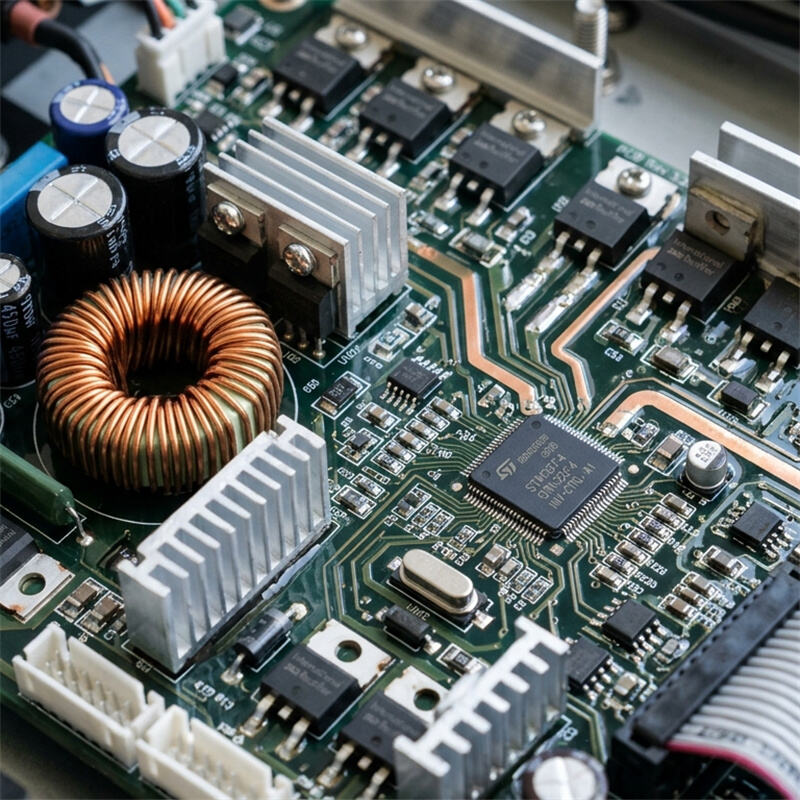
Conformal coating is a specialized, thin polymeric film applied directly to PCBs and electronic components. It conforms to the exact shape of the board, forming a continuous, protective barrier against moisture, salt, dust, and chemical contaminants.
To provide reliable protection in high-salt-mist island markets, the conformal coating must be applied with extreme precision, achieving the correct thickness and complete coverage:
- Material Selection: JYINS utilizes high-performance polyurethane and silicone-modified acrylic coatings. Polyurethane offers exceptional chemical and moisture resistance, while silicone-modified materials provide flexibility under extreme temperature cycles, preventing the coating from cracking or peeling over time.
- Dual-Sided Coating: Unprofessional manufacturers often coat only the top side of the PCB. JYINS implements a strict double-sided automated spray coating process, ensuring that the back of the board, component pins, and solder joints are equally protected.
- Thickness Control: The coating must be thin enough to allow components to dissipate heat, but thick enough to provide a reliable electrical barrier. JYINS maintains a uniform coating thickness of 50 to 100 microns, verified through automatic optical inspection (AOI) under ultraviolet light during manufacturing.
- Component Masking: Crucial components that rely on direct contact or physical movement, such as relays, terminals, and DIP switches, are carefully masked prior to the coating process to ensure their operational integrity is maintained.
Standards for Salt Mist Resistance: IEC 60068-2-52
When vetting inverters for island environments, procurement managers must look for official testing certifications. The global standard for evaluating salt-mist resistance is IEC 60068-2-52, titled Environmental Testing: Part 2-52: Tests: Salt Mist, Cyclic (Sodium Chloride Solution).
Unlike simple continuous spray tests, the cyclic test simulated in IEC 60068-2-52 represents real-world coastal conditions by exposing the equipment to alternating periods of salt spray and high-humidity storage. This cycling accelerates the corrosion process, testing whether the conformal coating and the outer enclosure can truly withstand the elements over a long lifetime.
JYINS inverters undergo rigorous testing under Severity Level 6, the most demanding level of IEC 60068-2-52, which is reserved for marine and offshore applications. Our inverters pass this testing with zero degradation in insulation resistance or power conversion efficiency, proving their suitability for coastal and island markets.
Enclosure Design: The First Line of Defense
While conformal coating protects the sensitive electronics inside, the inverter's external housing acts as the primary barrier against salt-mist ingress. For island projects, standard IP65 enclosures are often insufficient; JYINS utilizes advanced mechanical designs to maximize durability:
- Sealed Internal Compartments (IP66): Our high-power inverters utilize a dual-compartment architecture. The sensitive control PCBs and power electronics are housed inside a hermetically sealed, IP66-rated main chamber. The external cooling fans and heatsinks are isolated in a separate, open-air channel, preventing salt-laden air from ever coming into direct contact with the core electronics.
- Corrosion-Resistant Materials: The outer enclosure of JYINS inverters is constructed from high-grade aluminum alloys and treated with heavy-duty anti-corrosion powder coatings. External screws, brackets, and connectors are made of high-quality stainless steel (grade 316) to prevent rust and galvanic binding.
- Marine-Grade Connectors: AC and DC cable entries are secured using heavy-duty, UV-stabilized plastic glands with double rubber seals, preventing salt moisture from wicking along the cables into the inverter.
- Internal Air Circulation: To prevent heat build-up inside the sealed compartment without introducing external salty air, our inverters utilize internal heat exchangers. Internal fans circulate clean air inside the sealed chamber, transferring heat to the outer aluminum casing which is then cooled by the external fans.
By combining these physical enclosure features with advanced internal conformal coating, JYINS inverters offer a bulletproof solution for Caribbean and Pacific solar distributors, guaranteeing stable clean power generation and an extended system lifespan under the most demanding coastal conditions.