EN
EN


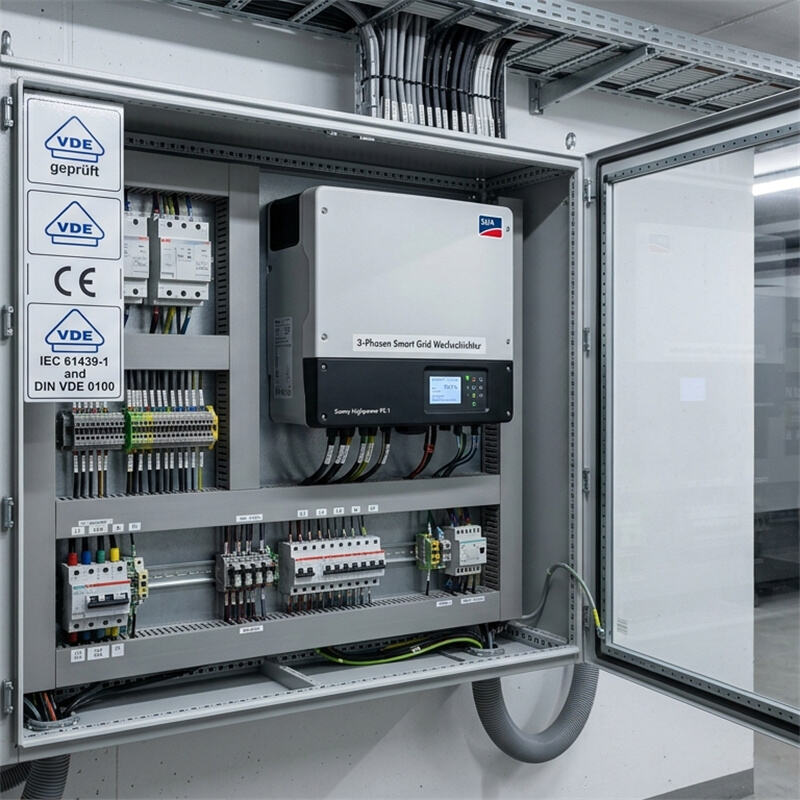
The German Low-Voltage Grid Standard: VDE-AR-N 4105
Germany is home to one of the most sophisticated and highly regulated electricity networks in the world. As the country pushes toward its Energiewende (energy transition), the integration of distributed solar power into the low-voltage grid must be carefully managed to maintain system safety and reliability. The foundational technical code governing this connection is the VDE-AR-N 4105 standard, titled Generators Connected to the Low-Voltage Distribution Network. This standard establishes strict rules for power quality, grid support, and safety behavior that all generation systems must meet. For German industrial plant managers, electrical engineers, and B2B solar developers, managing three-phase unbalance (known as Schieflast) is one of the most critical compliance requirements under VDE-AR-N 4105. Failure to keep the system balanced can lead to a refusal of connection by local distribution system operators (DSOs) or immediate grid disconnection.
This guide explains what three-phase unbalance is, why VDE-AR-N 4105 limits it, and how to successfully manage and configure your industrial solar power systems using advanced JYINS inverters and smart controllers.
Deconstructing Three-Phase Unbalance (Schieflast)
In a balanced three-phase Alternating Current (AC) network, the voltage and current waveforms of all three phases (L1, L2, and L3) have equal amplitudes and are shifted from each other by exactly 120 electrical degrees. Three-phase unbalance occurs when the electrical loads or generation capacities are not distributed equally across the three phases.
Why Grid Operators Limit Unbalance:
- Transformer Overheating: Unequal phase currents create a neutral current that flows back to the utility transformer. This current causes excessive heating in the transformer's neutral windings, reducing its lifetime and potentially causing premature failure.
- Voltage Distortions: High current on a single phase causes a localized voltage drop on that phase, while the other phases experience a voltage rise. This uneven voltage can damage sensitive three-phase industrial motors and electrical equipment.
- Ground Fault Tripping: Severe unbalance can trigger ground-fault or neutral-overcurrent protective relays at local substations, leading to localized power outages.
To prevent these issues, VDE-AR-N 4105 mandates that the maximum permissible active power unbalance between any two phases must not exceed 4.6 kVA. This limit applies to the point of common coupling (PCC) where the industrial facility connects to the public utility grid. Whether the unbalance is caused by single-phase consumer loads or unequal single-phase PV generation, the net unbalance must remain under this 4.6 kVA threshold.
Strategies for Mitigating Phase Unbalance in Industrial Setups
Managing phase unbalance in large industrial facilities requires a combination of strategic design, balanced load distribution, and smart inverter selection:
- Utilizing Three-Phase String Inverters: The simplest and most effective way to prevent generation-induced unbalance is to use dedicated three-phase string inverters, such as the JYINS commercial series. A three-phase inverter inherently balances its power output, injecting equal amounts of active power into L1, L2, and L3. Since the power is symmetrical, the inverter itself contributes zero to the facility's phase unbalance.
- Symmetrical Single-Phase Inverter Allocation: In smaller systems where single-phase inverters must be used, they must be installed in groups of three. By connecting equal capacities of single-phase inverters to L1, L2, and L3, the overall generation remains balanced. However, if one inverter shuts down due to a fault, the system will immediately experience an unbalance. To comply with VDE-AR-N 4105, these inverters must be communication-linked so that if one unit trips, the other two automatically throttle down to maintain the unbalance below 4.6 kVA.
- Phase Balancing of Industrial Loads: Industrial facilities are full of single-phase office equipment, lighting, and specialized machinery. Electrical engineers must audit the facility and distribute these loads as evenly as possible across the three phases. Symmetrical loading at the design phase minimizes the baseline unbalance that the solar system must interact with.
The Role of JYINS Inverters and External Smart Meters
While three-phase inverters solve the generation unbalance, the actual unbalance at the grid connection point is the net result of both generation and consumption. If an industrial facility has unbalanced loads, even a symmetrical three-phase solar inverter cannot correct it without intelligent control.
To resolve this, modern JYINS three-phase hybrid inverters support dynamic phase compensation and integrate with external smart meters:
- Real-Time Monitoring: A high-precision smart meter (such as a VDE-compliant Janitza or JYINS meter) is installed at the main grid connection point. This meter continuously monitors the current and active power on L1, L2, and L3, sampling multiple times per second.
- Dynamic Power Allocation (Phase-Independent Control): Standard three-phase inverters must output equal power on all phases. However, advanced JYINS hybrid inverters feature independent phase-power control. If the smart meter detects that L1 is importing 5 kW, while L2 and L3 are balanced, the JYINS inverter can adjust its internal switching to inject more power into L1 while reducing output on L2 and L3. This active phase compensation dynamically balances the net power flow at the utility meter.
- Battery Storage Integration: During times of extreme load unbalance, the JYINS hybrid inverter can draw energy from the battery bank to feed specific, heavily-loaded phases, keeping the net grid unbalance well below the VDE-AR-N 4105 limit of 4.6 kVA.
Commissioning and Documentation for German Utilities
Before a commercial solar facility can be authorized to operate in Germany, the local DSO (such as Westnetz, Netze BW, or Bayernwerk) will conduct a thorough grid-compatibility review. Developers must provide clear documentation showing compliance with VDE-AR-N 4105:
- Certificate of Conformity (Einheitenzertifikat): This document proves that the JYINS inverter has been tested and certified by an accredited European testing body to meet all VDE-AR-N 4105 requirements.
- Electrical Schematic: A detailed schematic showing the three-phase connections, safety relays, and the location of the external smart meter.
- Configuration Logs: Printed logs from the inverter commissioning software showing that the German grid profile was selected, the active phase compensation was enabled, and the fail-safe communication parameters are fully operational.
By partnering with JYINS and selecting our high-performance, fully certified three-phase inverters and hybrid energy storage systems, B2B solar distributors and EPCs can streamline their utility approval processes and deliver highly efficient, compliant, and durable industrial energy solutions across Germany.