EN
EN


The Regulatory Landscape of Net Metering and Export in India
India has seen a massive surge in commercial and industrial (C&I) solar installations, as businesses seek to lower high industrial electricity tariffs and meet environmental sustainability targets. However, the regulatory framework governing grid interconnection varies significantly across different states and regional distribution companies (DISCOMs). In many parts of India, utilities place strict limitations on the amount of solar energy that can be exported back into the grid. In some cases, net metering is capped at a low percentage of the consumer's sanctioned load, or it is banned entirely for high-capacity systems, enforcing a strict zero-export (or zero grid-feed-in) policy. For Indian C&I facilities, installing a solar system without proper export control can lead to heavy DISCOM penalties, safety trippings, or even the immediate disconnection of the main grid power supply. This guide explains how to integrate external zero-export controllers with JYINS inverters to ensure full compliance with regional Indian grid regulations.
Zero-export, also known as reverse power protection, is a control strategy that ensures the solar power system generates only enough electricity to cover the facility's instantaneous internal loads. The system must never allow surplus solar energy to flow backward across the utility meter. Achieving this requires high-speed, real-time coordination between the inverter and an external monitoring device.
The Technical Architecture of Zero-Export Control
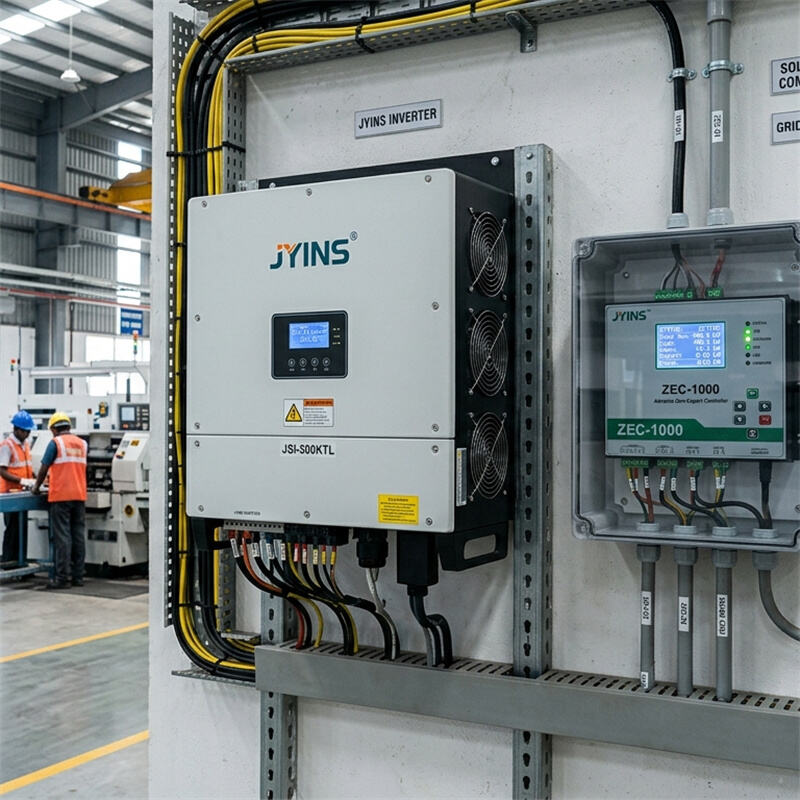
A typical zero-export control loop consists of three main components: the solar inverter, a smart power analyzer (or zero-export controller) installed at the main electrical incoming panel, and current transformers (CTs) wrapped around the incoming grid phases.
How the control loop operates:
- Measurement: The CT sensors continuously measure the direction and magnitude of current flowing between the facility and the utility grid.
- Analysis: The external zero-export controller reads these measurements. It calculates whether the facility is importing power, or if solar generation is beginning to exceed internal consumption, which would cause an export event.
- Adjustment: If the controller detects that the net power flow is approaching zero (or moving toward exporting), it sends a fast power-reduction command to the solar inverter via a Modbus communication link.
- Execution: The inverter's control microprocessor receives the command and curtails its active power output within milliseconds, adjusting the DC-DC boost converter's operating point to back away from the solar panels' Maximum Power Point (MPP).
By constantly adjusting the power output, the system maintains a safety buffer of import power (typically 1% to 2% of the total load), ensuring that no power is ever exported to the DISCOM grid, even during rapid load shedding or large machinery shut-offs.
Step-by-Step Physical Integration of JYINS Inverters
Integrating a JYINS commercial inverter with an external zero-export controller is straightforward, but it requires precise wiring and correct communication settings to ensure reliability.
Wiring the Communication Link:
- Communication Interface: JYINS inverters utilize standard RS-485 interfaces for external communication. Use a high-quality shielded twisted-pair (STP) cable (such as Cat5e or Cat6 STP) to connect the RS-485 port on the inverter to the Modbus RTU port on the zero-export controller.
- Termination Resistor: For long cable runs (exceeding 100 meters), enable the 120-ohm termination resistor on both the inverter and the controller to prevent signal reflection and data corruption.
- Shield Grounding: Connect the cable shield to a clean electrical ground at one end only, preferably at the controller side, to eliminate electromagnetic interference (EMI) from high-power factory machinery.
Inverter Configuration settings:
- Modbus ID: Assign a unique Modbus RTU client address (e.g., ID 1) to each inverter on the network.
- Baud Rate and Parity: Set the baud rate (typically 9600 bps or 19200 bps) and parity settings (8-N-1 is standard) to match the specifications of the zero-export controller.
- Active Power Control: In the inverter's advanced menu, enable external power control. This allows the inverter to accept dynamic active power limiting commands (usually writing to Modbus register 40001 or similar, depending on the specific JYINS model) from the external controller.
Selecting the Right Zero-Export Controller
JYINS inverters support integration with a wide variety of third-party power meters and dedicated zero-export controllers commonly available in the Indian market, such as those from Elmeasure, Janitza, and Schneider Electric, as well as our own proprietary JYINS Smart Metering solutions.
When selecting a controller for your C&I project, consider these features:
- High Sampling Rate: The controller should sample grid parameters at least 10 times per second (100 ms interval) to react quickly to sudden drops in factory load, such as an induction motor turning off.
- Multi-Inverter Support: If the factory has multiple JYINS inverters installed in parallel, the controller must be capable of distributing the power reduction commands proportionally across all units, maintaining system balance.
- Logging and Monitoring: Opt for controllers that feature cloud-based logging. This allows plant managers to monitor real-time generation, consumption, and export profiles via a web dashboard, providing valuable data for future energy-saving audits.
Commissioning and Testing for DISCOM Compliance
Once physical wiring and software configurations are complete, the system must undergo rigorous commissioning tests before it is inspected by utility officials.
Testing Checklist:
- No-Load Test: Temporarily shut down all major loads within the facility while the solar panels are generating maximum power. Verify that the inverter immediately curtails its output to near-zero, and check that the utility meter shows no reverse power flow.
- Step-Load Test: Turn on a large electrical load, wait for the inverter to ramp up, and then abruptly turn the load off. Monitor the RS-485 communication logs to ensure the controller registers the change and successfully commands the inverter to throttle down within the required response window (usually under 2 seconds).
- Fail-Safe Verification: Simulate a communication failure by disconnecting the RS-485 cable between the controller and the inverter. For safety compliance, the JYINS inverter must be configured to automatically ramp down its output to zero (or a pre-configured safe limit) within 5 seconds of losing connection with the controller.
By utilizing JYINS inverters with robust external zero-export controllers, Indian commercial solar developers can confidently execute projects in restricted net-metering zones. This combination offers high reliability, complete regulatory compliance, and a rapid return on investment for C&I enterprises across India.