EN
EN


Introduction: Why Material Science is the Unsung Hero of Power Electronics
When industrial procurement teams evaluate battery chargers, the discussion typically centers on electrical specifications: voltage, amperage, and charging algorithms. While these are critical, they only tell half the story. The longevity and safety of a battery charger in an industrial environment—where ambient temperatures can be high and duty cycles are demanding—are primarily determined by material science. For JYINS Electrical, engineering high-performance battery chargers means looking beyond the PCB and focusing on the physics of heat dissipation and structural durability.
The Battle Against Heat: Why Aluminum Reigns Supreme
Heat is the number one enemy of electronic components. For every 10°C increase in operating temperature, the life expectancy of electrolytic capacitors—the heart of many power units—can be cut by half. This makes thermal management the most important factor in charger design.
The Superiority of Aluminum Casings
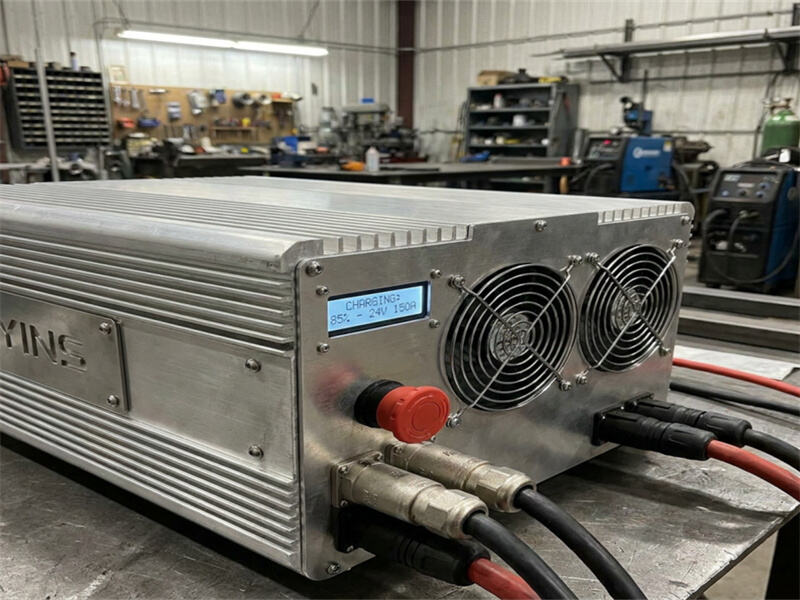
In the consumer market, plastic housings are common due to cost. However, in industrial settings, JYINS utilizes high-grade aluminum casings. Aluminum's thermal conductivity is significantly higher than that of plastic. An aluminum casing acts as a giant heat sink for the entire unit, pulling heat away from internal transformers and MOSFETs and radiating it into the surrounding air.
Furthermore, aluminum provides superior structural integrity. In a warehouse or factory setting, equipment is subject to vibrations, accidental impacts, and dust. A robust metal housing ensures that the delicate internal electronics remain protected throughout their service life.
Advanced Fan Logic: Intelligent Cooling for Longevity
While the casing provides passive cooling, industrial-grade chargers require active thermal management. However, not all fans are created equal. Constant-speed fans are noisy, draw unnecessary power, and pull more dust into the unit than required.
Load-Dependent Cooling
JYINS battery chargers feature intelligent fan logic. The fans are not just 'on' or 'off'; they are controlled by temperature sensors mounted on the most critical components. When the charger is operating at a light trickle-charge or in a cool environment, the fans remain at low RPM or even stop entirely. As the charging current increases and internal temperatures rise, the fan speed scales proportionally.
This 'smart' approach has three benefits:
1. Extended Fan Life: Fans are mechanical components with limited lifespans. By only running them when necessary, the service interval of the charger is extended.
2. Reduced Dust Accumulation: Less airflow when not needed means less dust and particulate matter are pulled into the casing, reducing the risk of internal short circuits over time.
3. Noise Reduction: In semi-office or workshop environments, a quieter charger improves the working conditions for personnel.
Internal Material Selection: Beyond the Casing
Material science also dictates the quality of the internal components. High-frequency transformers in JYINS chargers use high-grade copper windings and ferrite cores that minimize core losses (heat generation) and maximize conversion efficiency. Using lower-grade materials might save on cost, but it results in a unit that runs hotter and dies sooner. For industrial buyers, the Total Cost of Ownership (TCO) is always lower with a unit that uses premium internal materials.
Safety Protections: A Material and Logic Synthesis
Safety is not just a feature; it's a requirement. In industrial applications involving large lead-acid or lithium battery banks, a failure can lead to catastrophic fires or equipment damage. JYINS integrates multi-point safety protections that rely on both hardware materials and software logic:
- Overtemperature Protection: If for any reason—such as blocked ventilation—the unit exceeds its thermal threshold, the system will automatically reduce output or shut down to prevent fire.
- Short-Circuit Protection: Utilizing high-speed fuses and digital sensors to isolate faults instantly.
- Reverse Polarity Protection: Material design includes robust input terminals that can handle the stress of accidental incorrect connections without sustaining damage.
- Overvoltage & Overload: Precise voltage regulation ensures the battery is never overcharged, preserving the life of expensive battery assets.
Longevity in Harsh Environments
Industrial environments are rarely clean or temperature-controlled. Whether it's a coastal microgrid with salt-laden air or a dusty mining operation, the charger must endure. JYINS designs its chargers with these conditions in mind. This includes the use of conformal coatings on PCBs (printed circuit boards) to protect against moisture and corrosion, and the aforementioned aluminum casing to provide a physical barrier against the elements.
The Industrial Buyer's Checklist
When procuring battery chargers, we recommend looking for the following 'Material Science' indicators:
1. Chassis Material: Is it aluminum or low-grade plastic?
2. Thermal Strategy: Does it have intelligent fan control or a simple on/off fan?
3. Component Quality: Does the manufacturer specify the use of high-temperature rated capacitors and high-purity copper?
4. Certifications: Is the unit compliant with safety and EMC standards (like EMC Class B) required for industrial use?
Conclusion: Engineering Reliability
In the world of industrial power, reliability is the only currency that matters. By focusing on the science of materials—from the thermal properties of the aluminum casing to the intelligence of the cooling fans—JYINS Electrical delivers battery chargers that don't just work; they last. For procurement professionals, understanding these technical nuances is the key to selecting equipment that provides safe, long-term value and minimizes operational downtime. Investing in material science today is the best way to ensure the energy infrastructure of tomorrow.
Table of Contents
- Introduction: Why Material Science is the Unsung Hero of Power Electronics
- The Battle Against Heat: Why Aluminum Reigns Supreme
- Advanced Fan Logic: Intelligent Cooling for Longevity
- Internal Material Selection: Beyond the Casing
- Safety Protections: A Material and Logic Synthesis
- Longevity in Harsh Environments
- The Industrial Buyer's Checklist
- Conclusion: Engineering Reliability