EN
EN


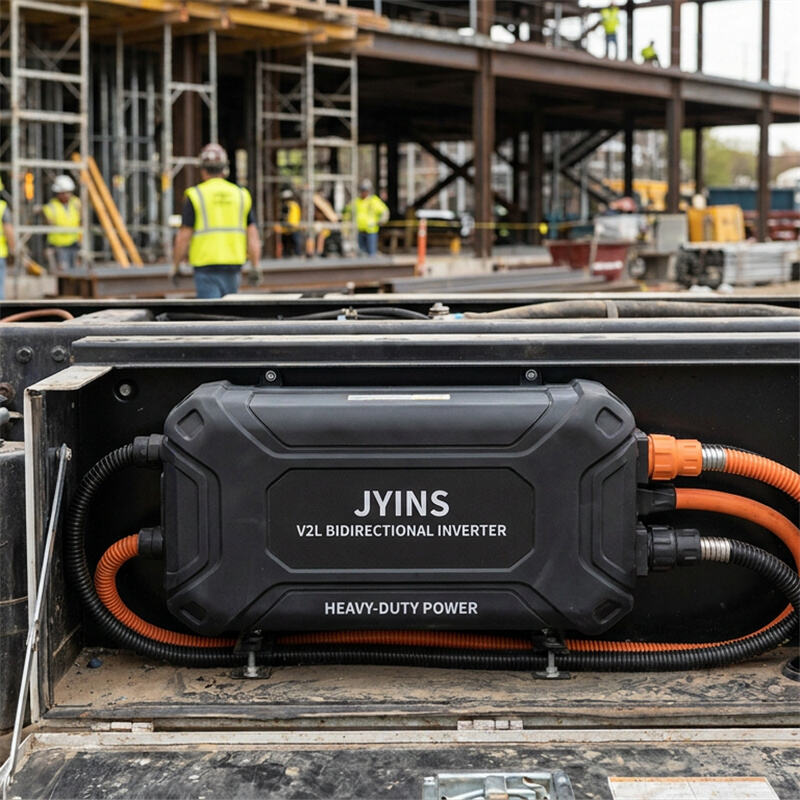
Q: The engineering of 'Bidirectional' V2L (Vehicle to Load) inverters for commercial construction fleets.
Introduction: Redefining Mobile Power on Construction Sites
Commercial construction sites are notoriously demanding environments in terms of power availability. During the initial phases of a project, grid connections are non-existent. Historically, site managers have relied heavily on noisy, carbon-emitting diesel generators to power heavy-duty rotary hammers, concrete saws, air compressors, battery chargers, and temporary job-site offices. These generators require constant fuel transport, require extensive maintenance, and introduce substantial carbon footprints.
As construction fleets transition to electric and hybrid utility trucks, a disruptive alternative has emerged: Vehicle-to-Load technology. A high-capacity electric commercial vehicle is essentially a massive, highly mobile battery energy storage system on wheels. By integrating an advanced 'bidirectional' V2L power inverter into the vehicle’s electrical architecture, the truck can utilize its high-voltage traction battery pack to deliver stable, grid-quality AC power directly to high-draw construction tools.
This technology requires sophisticated power electronics engineering. A V2L inverter is not just a standard one-way converter; it is a highly integrated, bidirectional energy hub. This guide explores the engineering behind bidirectional V2L inverters, the technical hurdles involved in fleet-level deployment, and how JYINS Electrical is helping shape the future of mobile commercial power.
What is a Bidirectional V2L Inverter?
Traditional power inverters operate in a single direction: they take DC power from a battery bank and convert it to AC power to run a load. Conversely, a standard battery charger takes AC power from the grid and converts it to DC to charge a battery.
A bidirectional V2L inverter combines both functions into a single, highly integrated power electronics module:
- Charging Mode (AC to DC): When the construction vehicle is parked at the fleet depot or connected to a grid outlet, the V2L inverter operates in reverse. It draws AC power from the grid, rectifies it to DC, and steps up the voltage to charge the vehicle’s traction battery pack.
- Discharge Mode / V2L Mode (DC to AC): When deployed on a construction site, the inverter draws high-voltage DC power from the traction battery, steps it down, and converts it into high-quality, pure sine wave AC power to run tools, lights, or communication nodes.
By combining these two modes, fleet operators eliminate the need for separate onboard chargers and heavy, external portable generators, maximizing vehicle payload capacity and reducing equipment complexity.
Key Engineering Challenges and Solutions in V2L Design
Designing bidirectional V2L systems for commercial construction fleets requires solving several complex technical challenges:
1. High-Voltage DC-DC Power Conversion
Modern commercial electric vehicles utilize high-voltage traction batteries operating between 400V DC and 800V DC. Safely and efficiently converting this high-voltage DC down to standard low-voltage AC (such as 120V or 240V AC) requires specialized power conversion topologies.
Engineers utilize Dual Active Bridge or bidirectional LLC resonant converters. These advanced topologies use high-frequency switching and a high-frequency planar transformer to provide galvanic isolation between the lethal high-voltage vehicle battery and the user-accessible AC output outlets. This isolation is a fundamental safety requirement, protecting workers on site from high-voltage DC shocks. JYINS bidirectional modules are designed with these isolated, high-efficiency topologies, keeping energy conversion losses below 6 to 7 percent.
2. Grid-Forming Control and Active Damping
When a V2L inverter is operating on a construction site, it acts as a 'grid-forming' source. Unlike standard grid-tied solar inverters, which simply synchronize with an existing utility grid, the V2L inverter must create its own stable local electrical grid from scratch.
This grid-forming role is highly demanding. Construction tools like concrete mixers and commercial saws represent inductive and non-linear loads that draw high, fluctuating inrush currents during startup. The V2L inverter must incorporate fast digital signal processors to execute real-time closed-loop control algorithms. These algorithms adjust the output voltage and frequency within microseconds to absorb load steps and mitigate voltage sags. Additionally, active damping filters are integrated to suppress harmonic resonance caused by variable-speed motor drives, ensuring clean power quality.
3. Rugged Grounding Systems for Job-Site Safety
Construction sites are outdoor environments often exposed to rain, mud, and wet soil. Safe electrical grounding is a paramount engineering priority.
Bidirectional V2L inverters must incorporate intelligent Ground Fault Circuit Interrupter and residual current monitoring devices. When operating in V2L mode, the inverter must dynamically configure its internal grounding system to ensure that any ground fault is immediately detected and the AC output is shut down within milliseconds. JYINS V2L control modules feature integrated ground monitoring relays that verify ground-loop integrity before enabling AC power delivery, providing maximum protection for site workers.
4. Heavy-Duty Thermal and Environmental Protection
Onboard vehicle electronics must survive extreme physical stress. A V2L inverter mounted inside a construction vehicle is subjected to intense engine bay heat, continuous road vibrations, and potential water splashing.
To ensure survival, V2L inverters are engineered with heavy-duty liquid-cooled or advanced heatsink-cooled chassis. Liquid cooling leverages the vehicle’s main coolant loop to maintain optimal semiconductor temperatures under continuous high-power discharges. All PCBs are protected with automotive-grade conformal coatings, and the entire assembly is rated to IP66 or IP67 standards to block water and fine masonry dust from entering the electronics.
Operational Benefits for Construction Fleet Owners
Integrating bidirectional V2L technology into your commercial fleet delivers substantial business benefits:
- Elimination of Fuel Costs: Running tools off a massive vehicle battery is significantly cheaper than burning diesel in small, inefficient portable generators.
- Noise Reduction: Quiet V2L power allows construction crews to work in urban areas with strict noise ordinances, enabling early-morning or late-night operations.
- Reduced Fleet Maintenance: Standard generators require frequent oil changes and spark plug replacements. Eliminating them simplifies fleet maintenance and reduces operational downtime.
- Green Business Branding: Operating a zero-emission job-site helps construction companies win municipal contracts that prioritize sustainable building practices.
Conclusion: Driving the Future of Mobile Power with JYINS
Bidirectional V2L inverter technology is transforming how commercial fleets approach mobile energy. By converting electric utility vehicles into active, high-power mobile generators, construction companies can dramatically lower operating costs, improve job-site safety, and reduce environmental impact.
As a pioneer in industrial power electronics, JYINS Electrical is dedicated to designing the highly efficient, rugged, and safe bidirectional power conversion modules required to support the V2L revolution. Our advanced engineering solutions provide the precise voltage regulation, high galvanic isolation, and rugged environmental protections needed to keep your heavy tools running, no matter how tough the job site. Partner with JYINS to electrify your fleet operations.
Table of Contents
- Introduction: Redefining Mobile Power on Construction Sites
- What is a Bidirectional V2L Inverter?
- Key Engineering Challenges and Solutions in V2L Design
- 1. High-Voltage DC-DC Power Conversion
- 2. Grid-Forming Control and Active Damping
- 3. Rugged Grounding Systems for Job-Site Safety
- 4. Heavy-Duty Thermal and Environmental Protection
- Operational Benefits for Construction Fleet Owners
- Conclusion: Driving the Future of Mobile Power with JYINS