EN
EN


Q: Selecting Inverters for Underground Mining: Tackling vibration, humidity, and safety venting.
Introduction: The Most Demanding Environment on Earth
Underground mining is arguably the most hostile operating environment for electrical power electronics. Hundreds of meters below the Earth's surface, industrial machinery—such as heavy drills, transport vehicles, conveyor belts, ventilation systems, and communication nodes—must operate continuously to maintain safety and productivity. The DC-AC power inverters used to run this equipment from battery banks or DC buses are subjected to an onslaught of physical and chemical stresses that would instantly destroy standard commercial or residential-grade electronics.
In an underground mine, equipment failures are not just inconvenient; they are incredibly costly in terms of lost production and can compromise critical safety systems like mine shaft ventilation or emergency lighting. For B2B mine project managers, electrical engineers, and heavy equipment procurement officers, choosing a power inverter requires a deep analysis of ruggedized engineering specifications.
This article outlines the essential design features required for power inverters deployed in underground mining, focusing on three major environmental threats: mechanical vibration, extreme humidity/dust, and thermal/gas safety venting, and explains how JYINS Electrical high-reliability power solutions are engineered to meet these extreme challenges.
Mechanical Vibration: Preventing Structural and Electrical Failures
Underground mines are places of continuous mechanical shock and low-frequency vibration. Heavy blasting, deep-earth drilling, and the constant movement of massive, multi-ton haul trucks send severe shockwaves through the surrounding rock and any machinery mounted to it.
To survive this constant shaking, a mining-grade inverter must incorporate several mechanical design advancements:
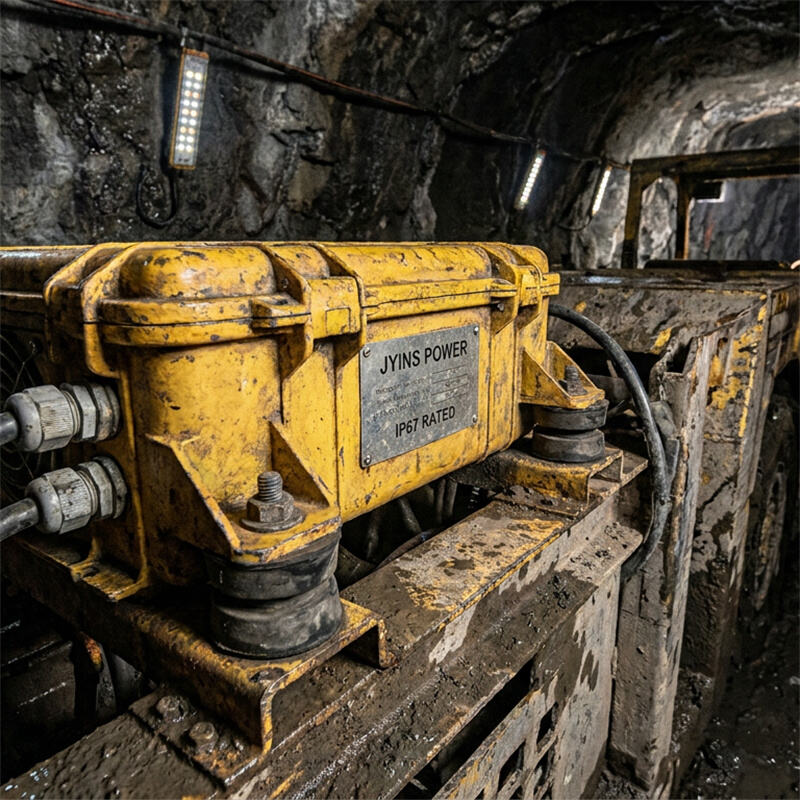
- Heavy-Duty Chassis and Shock-Absorbing Mounts: The inverter's outer enclosure must be constructed from thick, high-tensile steel or heavy-gauge anodized aluminum. The mounting brackets should integrate industrial elastomeric shock-absorbing dampers to isolate the internal electronics from high-impact mechanical forces.
- Component Potting and Anchoring: High-mass electronic components inside the inverter, such as large copper toroidal transformers, power inductors, and high-capacity electrolytic capacitors, are highly vulnerable to vibration. Under continuous shaking, their solder joints can crack, leading to catastrophic electrical failure. Mining-grade inverters must utilize specialized epoxy potting compounds to physically anchor these components to the chassis, distributing mechanical stress evenly across the board.
- Spring-Loaded Terminal Blocks: Traditional screw terminals are prone to backing out and loosening over time when exposed to continuous vibration. This creates loose electrical connections that can cause arc-flashes or thermal failures. Inverters designed for mining must utilize spring-loaded cage clamp terminals, which provide continuous mechanical pressure on wire connections regardless of vibration levels.
High Humidity and Corrosive Dust: Combating Corrosion and Short Circuits
Underground mines are frequently damp, humid, and filled with highly abrasive and conductive geological dust. Moisture from groundwater seepages can combine with sulfur or other mineral deposits to create highly corrosive chemical environments.
To protect delicate semiconductor chips, digital signal processors, and high-voltage traces from short circuits and corrosion, the inverter must implement robust barrier technologies:
- Conformal Coating on PCBs: All internal printed circuit boards must be heavily coated with a high-grade polyurethane or silicone conformal coating. This protective layer acts as a complete barrier against moisture, humidity, and fine conductive dust, preventing dendrite growth and leakage currents between high-voltage pins.
- High Ingress Protection (IP) Ratings: The inverter's enclosure must feature a high IP rating, such as IP56 or IP65, depending on the mounting location. For highly exposed applications, a completely sealed, fanless heatsink-cooled chassis is preferred. If active fan-cooling is necessary, the design must utilize isolated cooling channels, where cooling air is blown across external heatsink fins, keeping the dusty, humid intake air completely separated from the sealed internal electronics compartment.
- Corrosive-Resistant Finishes: External heat dissipation fins, mounting screws, and terminal connectors must be treated with corrosion-resistant coatings, such as marine-grade anodization or stainless-steel fasteners, to prevent rust and galvanic oxidation in humid shafts.
Safety Venting: Preventing Explosion and Thermal Risks in Confined Spaces
Safety is the absolute priority in underground mining operations. The buildup of explosive gases (such as methane) and coal dust in confined mine shafts presents a continuous risk of fire and explosion. Furthermore, lithium-ion battery banks and power conversion electronics can vent toxic or flammable gases if they experience an extreme thermal event.
Therefore, power inverters and their associated enclosures must incorporate advanced safety venting systems:
- Explosion-Proof Enclosures (Flameproof Design): For highly hazardous zones, inverters must be housed in certified flameproof enclosures (such as ATEX or MSHA certified). These enclosures are engineered to withstand an internal electrical explosion without allowing any flames or sparks to escape into the surrounding mine atmosphere.
- Pressure-Relief Safety Vents: In standard rugged enclosures, high temperatures can cause internal air pressure to fluctuate, drawing damp mine air inside when the unit cools down. Implementing smart, breathable membrane vents (such as Gore-Tex vents) allows the inverter enclosure to equalize pressure and vent any harmless gas buildup while remaining completely waterproof and dustproof.
- Active Degassing Paths: When integrated into enclosed battery-backed UPS cabins, the power system must feature dedicated degassing tubes to safely channel any outgassed battery vapors directly into the mine's primary return air ventilation duct, keeping the local work area safe for miners.
Why Choose JYINS for Mining Power Infrastructure?
JYINS Electrical leverages decades of industrial power conversion experience to engineer specialized, heavy-duty pure sine wave inverters that excel in underground mining projects. Our ruggedized inverters feature:
- Multi-stage vibration isolation and epoxy-potted magnetic cores.
- Thick, marine-grade anodized aluminum enclosures rated for high Ingress Protection.
- Triple-coated conformal PCBs to survive 100 percent condensing humidity.
- Smart thermal management systems with isolated cooling pathways.
Conclusion: Investing in Mining Reliability with JYINS
In underground mining, cutting corners on equipment specifications is a high-risk gamble. A standard commercial inverter will quickly fail when exposed to the intense vibrations, moisture, and dust of a mine shaft, costing your operation valuable hours of downtime and putting safety systems at risk.
By selecting JYINS mining-grade pure sine wave inverters, B2B project managers and electrical engineers make a strategic investment in long-term operational safety and equipment longevity. Our ruggedized power conversion systems deliver clean, stable power under the most grueling subterranean conditions, ensuring your team has the power they need to work safely and productively. Partner with JYINS to secure your underground power supply.
Table of Contents
- Introduction: The Most Demanding Environment on Earth
- Mechanical Vibration: Preventing Structural and Electrical Failures
- High Humidity and Corrosive Dust: Combating Corrosion and Short Circuits
- Safety Venting: Preventing Explosion and Thermal Risks in Confined Spaces
- Why Choose JYINS for Mining Power Infrastructure?
- Conclusion: Investing in Mining Reliability with JYINS