EN
EN


Introduction: The Brutal Demands of Open-Ocean Power Systems
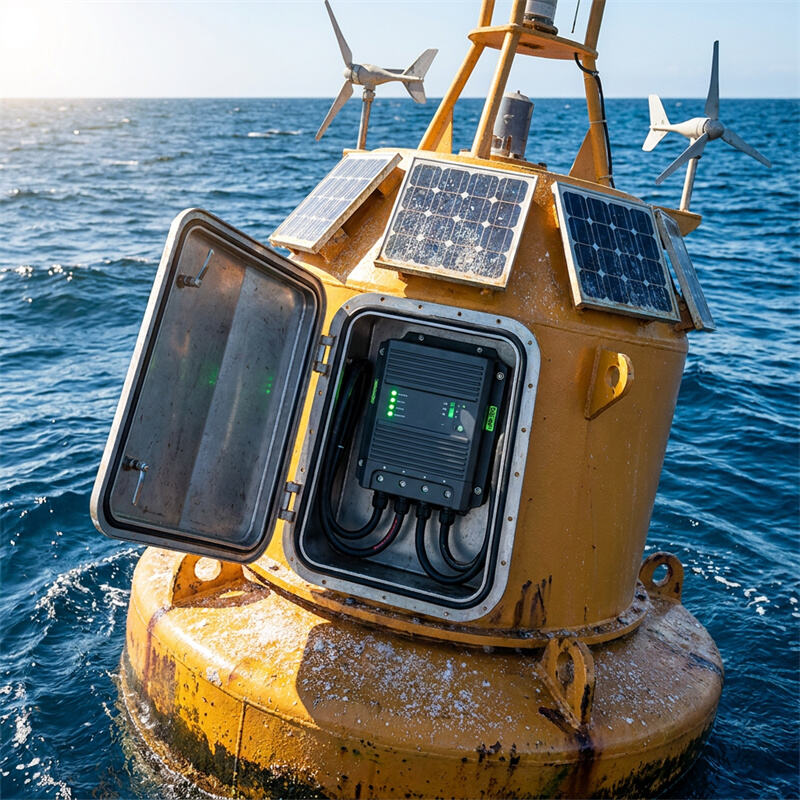
Remote maritime buoys play a vital role in global oceanography, weather forecasting, maritime navigation, scientific research, and offshore oil and gas operations. Floating hundreds of miles from the nearest coastline, these autonomous outposts host sensitive scientific sensors, high-frequency radar arrays, GPS receivers, and satellite telemetry transmitters. Keeping these critical electronics powered continuously in the middle of the ocean is a massive engineering challenge.
Because of their remote locations, physical maintenance on ocean buoys is astronomically expensive, requiring specialized vessels and team deployments. Therefore, the power conversion systems installed within these buoys must operate with absolute autonomy and reliability for years. For B2B procurement managers and marine system integrators, sourcing power inverters for remote maritime buoys means evaluating hardware under the most punishing environmental and electrical criteria.
Q: What are the key technical specifications to evaluate when sourcing power inverters for remote maritime buoys operating in harsh open-ocean environments?
Answer:
When sourcing inverters for remote maritime buoys, system integrators must prioritize three major categories of technical specifications: marine-grade environmental protection, integrated multi-source energy harvesting and power management, and ultra-low power standby consumption coupled with industrial telemetry interfaces.
Specifically, the inverters must feature IP67 or IP68 hermetically sealed enclosures made from corrosion-resistant anodized aluminum, along with heavy-duty conformal coating on all PCBs to withstand constant salt spray and high relative humidity. The inverter should also support multi-source DC inputs (solar, wind, and wave kinetic) managed by advanced Maximum Power Point Tracking (MPPT) controllers. Finally, it must incorporate ultra-low standby self-consumption modes to preserve precious battery reserves during periods of low energy harvest, and provide isolated RS-485, CAN bus, or Modbus communication interfaces to stream real-time telemetry back to central satellite links.
Crucial Specification 1: Marine-Grade Environmental Engineering
Saltwater is highly corrosive and electrically conductive. Even inside the dry compartments of an ocean buoy, saline moisture can penetrate standard enclosures, causing rapid galvanic corrosion, component bridging, and catastrophic electrical failure.
- Ingress Protection (IP67/IP68): Standard power inverters with ventilation holes or active fan cooling are entirely unsuitable for maritime applications. Buoy inverters must utilize fully sealed, fanless IP67 or IP68 enclosures. Cooling must be achieved entirely through conduction, using integrated aluminum cooling fins to transfer heat directly to the buoy's structural steel or surrounding seawater.
- Advanced Anti-Corrosion Materials: The inverter enclosure must be manufactured from marine-grade materials, such as anodized aluminum or stainless steel, capable of withstanding constant exposure to saltwater and high-salinity air. All external hardware, including mounting brackets, glands, and connector screws, must use high-tensile stainless steel to prevent rust.
- Conformal Coatings and Thermal Potting: The internal electronics must have multiple protective layers. Sourcing teams should look for inverters where all printed circuit boards have undergone automatic double-pass polyurethane or acrylic conformal coating. For extreme conditions, full silicone potting is preferred, which completely isolates the electronic components from moisture, dust, and mechanical vibration caused by rough seas.
Crucial Specification 2: Multi-Source Energy Harvesting and MPPT Integration
Remote buoys cannot rely on a single energy source. Cloudy weeks or calm winds can easily disable single-source solar or wind power systems. Modern buoys utilize multi-source energy harvesting, combining solar PV, micro-wind turbines, and wave kinetic generators.
- Dedicated Dual-Input MPPT: An ideal marine inverter or hybrid charge controller must integrate multiple, independent Maximum Power Point Tracking (MPPT) charge controller channels. This allows the system to optimize power collection from solar panels and wind turbines simultaneously, even when both sources have vastly different electrical characteristics.
- Handling Dynamic Kinetic Inputs: Wave-energy and wind-kinetic inputs generate highly variable, high-voltage AC spikes. Sourcing managers must ensure that the charge-controller stage of the marine inverter system includes dynamic over-voltage protection circuits and active braking control loops to protect the internal battery bank from voltage surges during high-wind or high-wave storm events.
Crucial Specification 3: Standby Self-Consumption and Telemetry Interfaces
In a remote marine environment, every milliwatt counts. During prolonged periods of heavy storm activity or short winter days, the buoy's energy harvesting capabilities can fall to near zero.
- Minimal Self-Consumption: Standard industrial inverters often consume 10 to 30 watts of power just to keep their internal electronics active. For a remote buoy, this parasitic drain can quickly deplete the backup battery bank. Marine-grade inverters must feature high-efficiency sleep or standby modes where idle power consumption is restricted to less than one watt. The inverter must awaken instantly when a household AC load is triggered or when a scheduled telemetry transmission begins.
- Isolated Telemetry Communication: The inverter must act as an active IoT node within the buoy's system. It must export critical telemetry metrics, including battery State of Charge, real-time energy harvesting rates, AC output current, and internal temperature profiles. This data is transmitted via isolated RS-485, CAN bus, or Modbus RTU ports to the buoy's central satellite or cellular modem. Galvanic isolation on these communication lines is essential to prevent electrical noise from the high-power inverter stages from interfering with sensitive GPS and RF sensors.
Partnering with JYINS Electrical for Marine-Grade Power Procurement
At JYINS Electrical, we have spent decades refining our power conversion technology to withstand the most challenging environments on earth. Our dedicated marine-grade power inverters and hybrid controllers are engineered specifically for long-term deployment in remote, high-salinity maritime applications:
- Sealed Conduction Cooling: Our marine inverters use heavy, fanless anodized aluminum alloy heatsinks, providing exceptional thermal dissipation while maintaining a completely sealed IP67 environment.
- Double-Pass Conformal Coating: Every PCB manufactured by JYINS is coated in-house using computerized selective coating machines, ensuring perfect, repeatable insulation barriers on all solder points.
- High-Reliability Components: We source long-life, military-grade solid-state capacitors and magnetic components to ensure our inverters maintain peak efficiency under continuous vibration and thermal cycling.
- Comprehensive Telemetry Integration: Our equipment is designed with fully isolated communication interfaces, making it easy for marine system integrators to map our Modbus register outputs to satellite telemetry systems.
B2B Sourcing Recommendations for Marine System Integrators
When writing the procurement specifications for your next offshore buoy project, keep these three engineering rules in mind:
- Avoid Active Fan-Cooled Inverters: Always mandate fanless, conduction-cooled, sealed IP67 designs to eliminate a major point of physical failure and prevent saline air ingestion.
- Mandate Galvanically Isolated Communications: Ensure that all data interfaces (CAN, RS-485) are electrically isolated to prevent high-power inverter switching noise from degrading the buoy's scientific sensor and RF data quality.
- Demand Vibration Testing Reports: Verify that the inverter manufacturer has tested their hardware against high mechanical shock and vibration standards, ensuring it can survive continuous wave impacts in rough seas.
In conclusion, sourcing power inverters for remote maritime buoys requires a deep understanding of marine environmental engineering, multi-source MPPT integration, and ultra-low-power electronics. By prioritizing IP67 hermetic sealing, low standby self-consumption, and robust telemetry integration, marine project developers can ensure their autonomous offshore networks remain active and reliable, year after year.
Table of Contents
- Introduction: The Brutal Demands of Open-Ocean Power Systems
- Q: What are the key technical specifications to evaluate when sourcing power inverters for remote maritime buoys operating in harsh open-ocean environments?
- Answer:
- Crucial Specification 1: Marine-Grade Environmental Engineering
- Crucial Specification 2: Multi-Source Energy Harvesting and MPPT Integration
- Crucial Specification 3: Standby Self-Consumption and Telemetry Interfaces
- Partnering with JYINS Electrical for Marine-Grade Power Procurement
- B2B Sourcing Recommendations for Marine System Integrators