EN
EN


Q: How to implement 'Export Limitation' in B2B solar hybrid systems for grid-restricted regions?
Introduction: The Challenge of Grid-Restricted Solar Integration
As commercial and industrial enterprises globally transition to solar energy to hedge against rising utility costs, they face a growing regulatory hurdle: utility grid restrictions. In many municipal networks, particularly in older urban environments or congested regions with high solar penetration, local grid operators prohibit commercial businesses from exporting excess solar energy back into the utility grid. These zero-export or export-limited regulations are designed to prevent local grid over-voltage sags and frequency instability.
For B2B solar project developers, commercial building owners, and industrial facility managers, these restrictions do not mean solar energy is off-limits. Instead, they require the implementation of an active, highly reliable export limitation system. This system ensures that the solar array generates exactly what the building consumes, or stores any surplus power locally, but never allows power to flow backward into the utility grid.
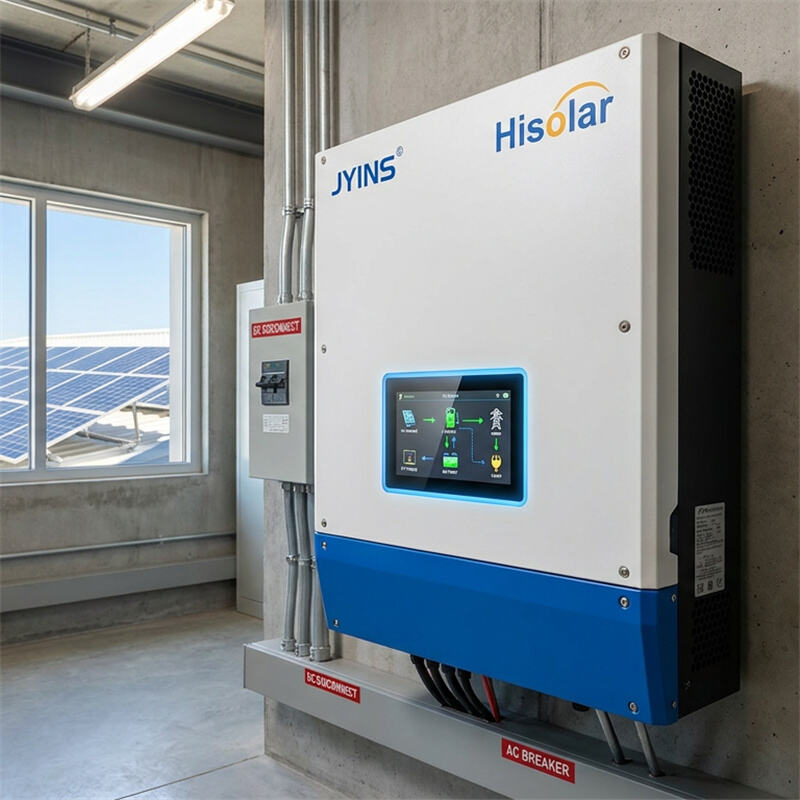
Implementing a robust export limitation system requires a precise combination of advanced hybrid inverters, ultra-fast smart energy meters, and smart control algorithms. This engineering guide details how to design and implement export limitation in commercial B2B solar hybrid systems, demonstrating how JYINS Hisolar series hybrid inverters achieve regulatory compliance and maximize local solar utilization.
Understanding the Core Mechanism of Export Limitation
Export limitation, often referred to as zero-export, is a closed-loop active power control process. The system operates based on real-time feedback loop parameters:
- Real-Time Power Monitoring: A smart utility-grade energy meter, equipped with high-accuracy Current Transformers, is installed at the main grid connection point of the commercial facility. This meter continuously monitors the direction and magnitude of the power flow, tracking whether the building is importing power from the grid or attempting to export power.
- Communication Link: The smart energy meter is linked directly to the hybrid inverter via a high-speed RS485 or CAN bus industrial communication interface.
- Dynamic Inverter Throttling: If the smart meter detects that the local load has dropped and solar generation is about to exceed consumption, the hybrid inverter's microprocessor immediately calculates the surplus and throttles its AC active power output down within milliseconds. This process, known as active power derating, ensures that solar output perfectly matches the building's instantaneous load demand.
Step-by-Step Engineering Implementation of Export Limitation
To build a highly reliable, compliant zero-export commercial solar system, engineers should follow these essential steps:
1. High-Accuracy Current Transformer and Metering Placement
The foundation of any export limitation design is the measurement of power flow at the boundary between the facility and the utility grid. System designers must select a smart energy meter with high-accuracy split-core or solid-core CT clamps. The CTs must be positioned immediately downstream of the utility's main revenue meter, capturing all electrical currents entering or leaving the building.
The CTs must be rated for the full current capacity of the facility's main electrical service panel and oriented correctly according to the manufacturer's directions. Incorrect CT orientation is the most common installation error, causing the meter to misinterpret import power as export power, which can lead to system shut-downs or regulatory violations.
2. High-Speed Communication Networking
To prevent any transient export of solar power during sudden load drops (such as when a large AC chiller or elevator motor shuts off), the communication loop between the smart meter and the hybrid inverter must be exceptionally fast.
Engineers must establish a dedicated shielded twisted-pair RS485 communication line utilizing the Modbus RTU protocol. The baud rate should be configured to 9600 bps or higher, and the communication cables must be routed away from noisy AC power cables to prevent electromagnetic interference from distorting the signal packets. JYINS Hisolar hybrid inverters feature a dedicated, noise-isolated RS485 port specifically designed to interface seamlessly with approved smart energy meters.
3. Configuring the Hybrid Inverter's Control Parameters
Once the hardware is physically installed and wired, the system must be configured through the inverter's user interface. In a JYINS Hisolar hybrid setup, the project manager must access the system settings and activate the export control function:
- Set Export Limit Value: If the local utility allows zero export, the limit must be configured to 0W. If the utility allows a small amount of feed-in, the limit can be set to a specific kilowatt value (e.g., 10kW).
- Fail-Safe Activation: In the event of a communication failure between the smart meter and the inverter, the system must incorporate a fail-safe mode. The JYINS Hisolar inverter is programmed to immediately throttle its solar output to zero or a pre-defined safe minimum if communication is lost for more than a few seconds, preventing any accidental illegal export to the grid.
- Control Response Time: The control algorithm must have a response time of less than 1 or 2 seconds to comply with typical utility standards. JYINS inverters feature fast microprocessors that process meter data and adjust active power output within milliseconds.
4. Integrating Battery Energy Storage Systems (BESS)
The main drawback of a basic zero-export solar setup is grid curtailment. When solar generation is throttled to match a low local load, valuable solar energy is wasted.
Integrating a battery bank into the hybrid solar system solves this issue. When the smart meter detects surplus solar energy, the JYINS Hisolar hybrid inverter redirects the excess DC power to charge the battery bank instead of curtailing solar production. Once the battery is fully charged, and only then, does the inverter begin active power derating. Later, during peak energy rate periods or when the sun sets, the inverter discharges the batteries to power the facility, maximizing the ROI of the solar investment.
Why Choose JYINS Hisolar Hybrid Inverters for Grid-Restricted Projects?
JYINS Electrical has specifically engineered the Hisolar series to address the global demand for smart grid-compliant power electronics. Our commercial-grade hybrid systems provide:
- Seamless Meter Integration: Certified compatibility with leading industrial energy meters.
- Ultra-Fast DSP Control: Advanced digital signal processors that execute active power control loops at microsecond speeds, ensuring virtually zero grid back-feed transients.
- Robust Communication Fail-Safes: Automatic alarms and automatic output throttling if communication links are compromised.
- High-Quality Engineering: Built with premium, industrial-grade components to survive demanding commercial environments.
Conclusion: Navigating Utility Rules with JYINS Technology
As utility grids become increasingly congested, export limitation is transitioning from an occasional requirement to a standard necessity for commercial B2B solar installations. System developers can no longer rely on simple grid-tied inverters that lack dynamic power controls.
By implementing JYINS Hisolar hybrid inverters coupled with smart metering, commercial facilities can easily comply with the strictest zero-export utility mandates while capturing the full economic benefits of clean solar energy. JYINS provides the control speed, reliability, and battery-integration flexibility required to make your commercial solar project a compliant, high-performing success. Power your business on your own terms with JYINS.
Table of Contents
- Introduction: The Challenge of Grid-Restricted Solar Integration
- Understanding the Core Mechanism of Export Limitation
- Step-by-Step Engineering Implementation of Export Limitation
- 1. High-Accuracy Current Transformer and Metering Placement
- 2. High-Speed Communication Networking
- 3. Configuring the Hybrid Inverter's Control Parameters
- 4. Integrating Battery Energy Storage Systems (BESS)
- Why Choose JYINS Hisolar Hybrid Inverters for Grid-Restricted Projects?
- Conclusion: Navigating Utility Rules with JYINS Technology