EN
EN


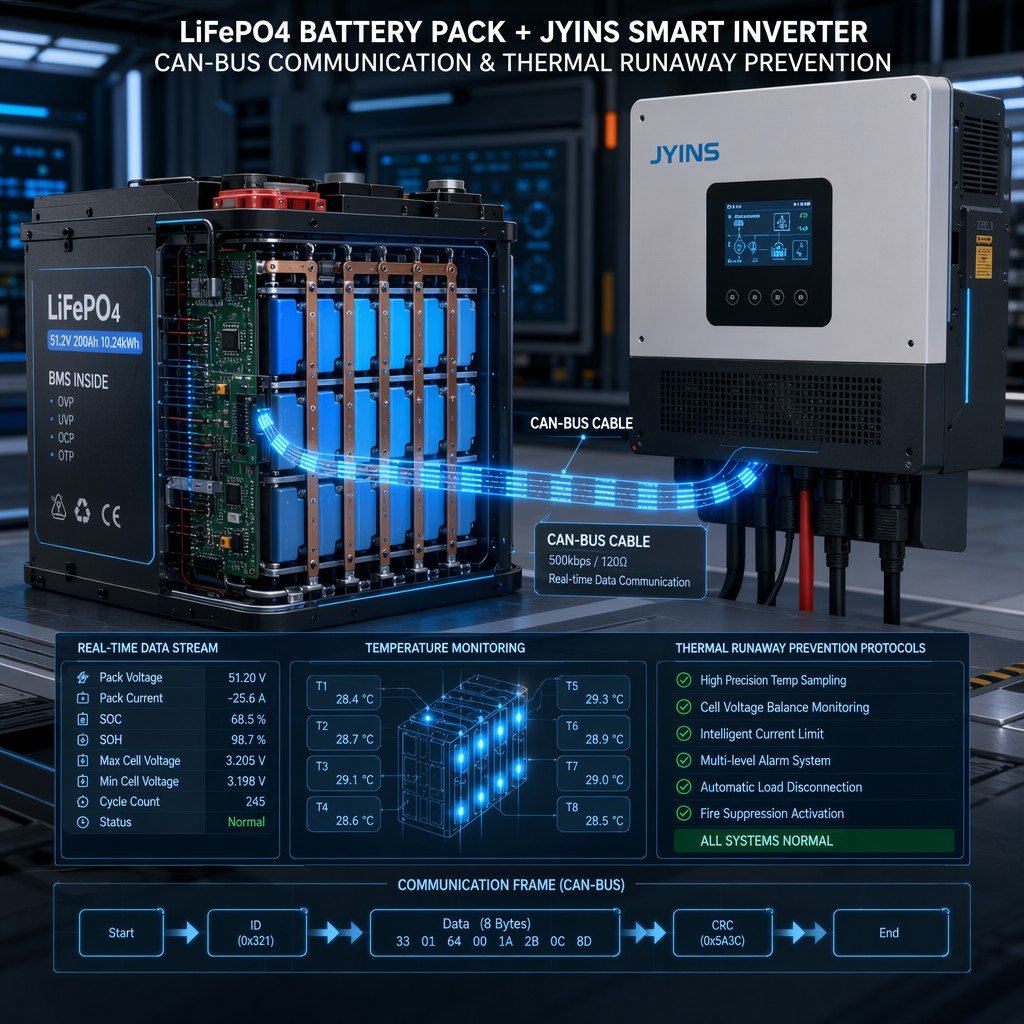
Q: What are the key steps in managing LiFePO4 battery pack thermal runaway prevention through a smart inverter and BMS protocol handshake?
A:
As lithium iron phosphate (LiFePO4) batteries are widely adopted in B2B energy storage projects, battery safety has become the decisive factor in project success. Although LiFePO4 is inherently more stable than ternary lithium (NMC), the risk of thermal runaway still exists under extreme overcharging, internal short circuits, or high-temperature environments. Traditional simple charge/discharge management (relying only on voltage thresholds) is no longer sufficient to meet high safety standards. Through deep protocol handshaking with the Battery Management System (BMS), JYINS smart inverters have made the leap from passive protection to active intervention. This article explains the core logic of this closed-loop management system.
1. Why Is the Protocol Handshake the First Line of Defense for Safety?
In non-communication mode, the inverter estimates battery status by measuring the total pack voltage. But a battery pack is made up of hundreds or thousands of cells connected in series and parallel. A normal total voltage does not mean that no individual cell is overheating. If a defective cell experiences an abnormal temperature rise, the inverter cannot detect it, and continuing to push current into the pack will directly trigger thermal runaway.
- Definition of protocol handshake: the inverter exchanges data with the BMS over a CAN or RS485 physical interface. The BMS acts as the brain, while the inverter acts as the actuator.
- Closed-loop control: the BMS sends the maximum cell temperature, minimum cell temperature, individual cell voltages, and fault codes to the JYINS inverter in real time, and the inverter precisely adjusts charge/discharge power based on this data.
2. JYINS' Four Management Mechanisms for Thermal Runaway Prevention
1. Dynamic Current Limiting (ACL)
When the BMS detects that the maximum internal temperature of the battery pack is approaching the warning threshold (e.g., 45°C), it sends a reduce-load request to the JYINS inverter over the protocol. The inverter immediately lowers the charging current linearly, reducing the chemical heat generated inside the electrolyte and allowing the pack to cool down smoothly. This current-limiting-for-cooling mechanism effectively prevents localized overheating from escalating into full thermal runaway.
2. Abnormal Temperature Rise Slope Monitoring
In addition to absolute temperature, JYINS' intelligent monitoring software can analyze the rate of temperature change. If a cell's temperature rises too quickly over a short period (even before reaching the cutoff threshold), the system flags it as a potential internal short circuit or connection abnormality and triggers a warning. B2B operations and maintenance personnel receive instant notifications and can perform on-site inspections before an incident occurs.
3. Precise Integration of High/Low Voltage Protection
Different LiFePO4 cell manufacturers have different chemical characteristics. Through the protocol handshake, the JYINS inverter can automatically read the overcharge protection (OVP) and over-discharge protection (UVP) points set by the BMS. This avoids the chronic sub-health battery condition caused by manual parameter errors — a condition that is one of the triggers for thermal runaway.
4. Fault Lockout and Forced Relay Disconnection
In extreme cases, if the BMS detects serious precursors of thermal runaway (such as smoke alarms or extreme high temperatures), it issues an emergency cutoff command over the protocol. The JYINS inverter instantly opens the DC-side circuit. For systems with integrated DC contactors, the inverter can also work with the BMS to achieve a physical dual disconnection, ensuring the current drops completely to zero.
3. Configuration Essentials for B2B Engineers
- Physical link inspection: in B2B project delivery, make sure the CAN/RS485 shielded cable connections are reliable. Use high-flexibility, interference-resistant signal cables and ensure the communication ground potentials are consistent.
- Protocol compatibility verification: JYINS inverters come with pre-loaded communication protocols for dozens of mainstream lithium battery brands worldwide (such as Pylontech, BYD, LG, etc.). When selecting equipment, confirm that the inverter firmware version matches the protocol library of the battery BMS.
- Redundant design: in addition to the communication closed loop, we still recommend keeping the inverter's built-in voltage/current hardware protection as a second backup. Even if communication is interrupted, the inverter can still operate independently based on preset conservative parameters.
4. Business Value: Protecting Assets and Compliance
For B2B customers (such as commercial warehouses and base station operators), battery safety directly affects insurance premiums and operating licenses. A JYINS system with intelligent protocol handshaking can significantly reduce fire risk. It not only protects expensive hardware assets, but also ensures the safety of surrounding buildings and personnel — making it a cornerstone of any sustainable energy strategy.
5. Conclusion
LiFePO4 battery thermal runaway prevention should not be carried out in isolation. Through the protocol handshake between JYINS smart inverters and the BMS, we build a holistic safety architecture with shared information and rapid response. This refined, cell-level management approach is the inevitable choice for modern B2B energy storage solutions on the path to intelligence. In the power and energy industry, true leadership is not only about efficiency gains, but also about the ultimate protection of the safety baseline.
Table of Contents
- Q: What are the key steps in managing LiFePO4 battery pack thermal runaway prevention through a smart inverter and BMS protocol handshake?
- A:
- 1. Why Is the Protocol Handshake the First Line of Defense for Safety?
- 2. JYINS' Four Management Mechanisms for Thermal Runaway Prevention
- 3. Configuration Essentials for B2B Engineers
- 4. Business Value: Protecting Assets and Compliance
- 5. Conclusion