EN
EN


Q: How can the inverter dry contact interface be used to trigger real-time load shedding and prioritize critical B2B equipment?
A:
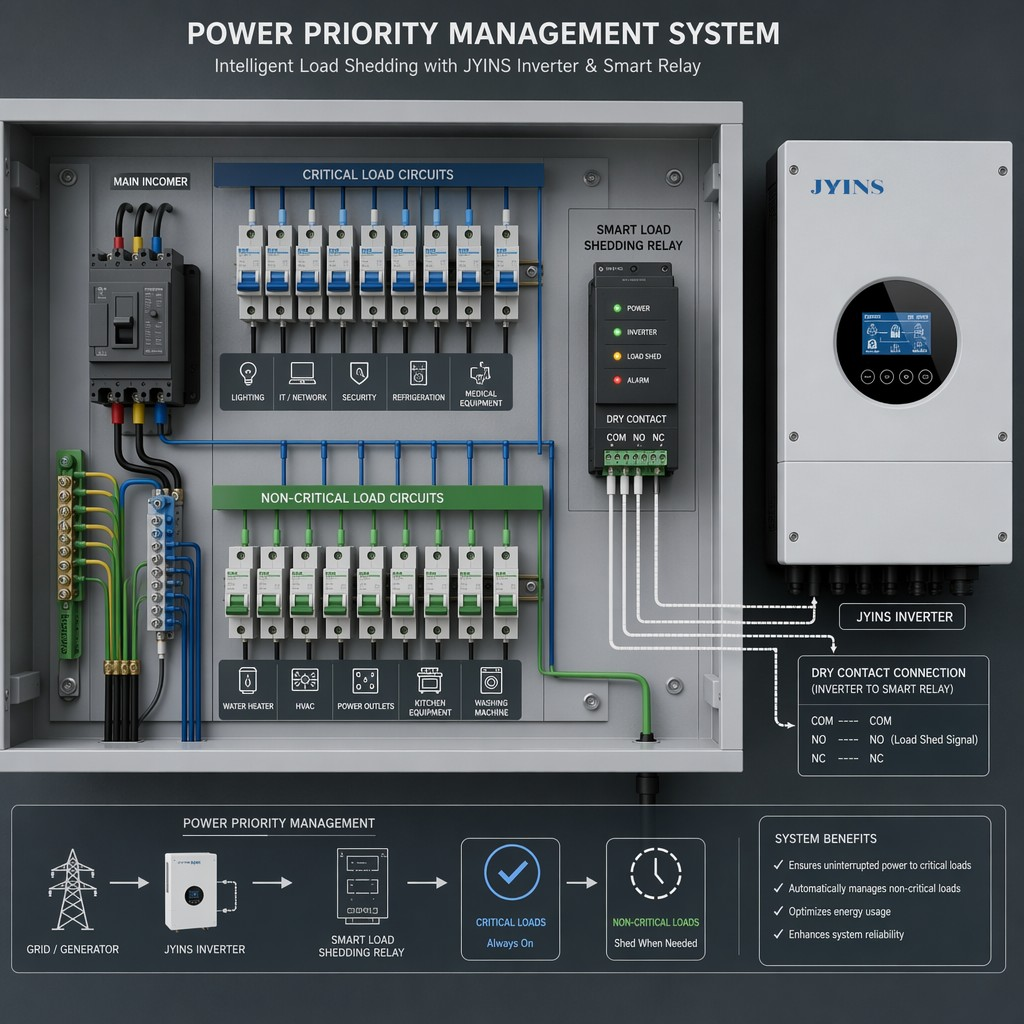
When energy is limited — during cloudy days, at night, or when battery capacity is low — keeping critical equipment in B2B environments (such as servers, security surveillance, life-support systems, or precision machine tools) running is a core objective of power system design. Rather than letting all loads shut down together when the battery runs out, a smarter strategy is to implement real-time load shedding. The built-in dry contact interface on JYINS industrial-grade inverters provides a simple, reliable way to implement this capability. This article explains how to use this hardware interface to build a tiered load management system.
1. What Is a Dry Contact Interface and How Does It Support Load Shedding?
A dry contact is a passive switch interface. It does not output voltage; it only transmits a signal through the open/close action of an internal relay. Its greatest advantage is electrical isolation, which allows it to be safely connected to control circuits operating at different voltage levels.
In the JYINS inverter management logic, the dry contact can be programmed as a battery status alarm trigger. For example, when the battery voltage drops to 20% SOC (State of Charge), or when the inverter approaches its overload threshold, the dry contact closes. This signal can then serve as the command source for a downstream load-shedding controller.
2. Designing a Three-Tier Load Management Architecture
In a typical B2B project, loads are usually divided into three categories:
- Tier 1 loads (critical): servers, emergency lighting, control center. Must run 24/7.
- Tier 2 loads (non-critical): office air conditioning, breakroom outlets. Can be the first to be shed during a power shortage.
- Tier 3 loads (sheddable): some landscape lighting, non-essential EV chargers. Run only when energy is sufficient.
3. Implementation Steps Based on the JYINS Interface
1. Hardware Connection: Dry Contact Driving an AC Contactor
Because the dry contact's own current-carrying capacity is limited (typically below 5A/250VAC), it cannot directly cut off high-power loads such as air conditioners. The correct approach is:
- Run two control wires from the JYINS inverter's Dry Contact to the coil circuit of an Intermediate Relay or AC Contactor.
- Connect the contactor's normally open contacts in series with the supply circuit of the Tier 2 loads.
2. Logic Setup: Configuring the Trigger Thresholds
Enter the JYINS inverter's setup menu or use the WiFi monitoring app:
- Find the Dry Contact Function option.
- Set it to Voltage Controlled or SOC Controlled.
- Define the cutoff point: for example, set the dry contact to activate when the battery voltage drops below 46V (for a 48V system), releasing the AC contactor and disconnecting non-critical loads.
- Define the recovery point: set the dry contact to reset and reconnect non-critical loads when the battery voltage recovers to 52V (or 10 minutes after charging begins).
3. Multi-Logic Integration: Overload-Protection Load Shedding
In addition to voltage control, the JYINS inverter also supports power-based load shedding triggers. If the instantaneous total load exceeds 90% of the inverter's rated power, the dry contact can immediately cut off Tier 3 loads, preventing the inverter from entering hardware overload protection (shut down) and ensuring Tier 1 loads never lose power.
4. Advanced Solution: Integration with a PLC or Smart Gateway
For more complex B2B campuses, the JYINS dry contact can be connected to the site's PLC (Programmable Logic Controller) system. After receiving the inverter's pre-alarm signal, the PLC can trip the circuit breakers in the distribution panel one by one according to a preset priority order, while simultaneously sending SMS alerts to the operations and maintenance team. This hardware-plus-software approach to load shedding is more precise and flexible.
5. Business Value and Maintenance Advantages
- Extended emergency runtime: by shedding 50% of non-critical loads, the runtime of critical equipment can be directly doubled, buying valuable time for power restoration crews.
- Asset protection: avoids thermal damage caused by the inverter frequently operating at the edge of overload, improving the durability of the entire power system.
- Higher customer satisfaction: in B2B managed services, this kind of intelligent tiered power assurance is an important selling point that demonstrates a professional level of service.
6. Conclusion
The inverter dry contact interface may be small, but it is an important bridge to refined energy management. With the flexible configuration options offered by JYINS, engineers can build an efficient, automatic real-time load shedding defense line without purchasing an expensive third-party grid management system. This not only protects the power supply to B2B customers' core assets, but also takes the energy utilization efficiency of off-grid and microgrid systems to a new level.
Table of Contents
- Q: How can the inverter dry contact interface be used to trigger real-time load shedding and prioritize critical B2B equipment?
- A:
- 1. What Is a Dry Contact Interface and How Does It Support Load Shedding?
- 2. Designing a Three-Tier Load Management Architecture
- 3. Implementation Steps Based on the JYINS Interface
- 4. Advanced Solution: Integration with a PLC or Smart Gateway
- 5. Business Value and Maintenance Advantages
- 6. Conclusion