EN
EN


Q: Procurement Director's Guide: How Do Dual-Channel MPPT Inverters Optimize Energy Yield Under Complex Commercial Roof Shading?
A:
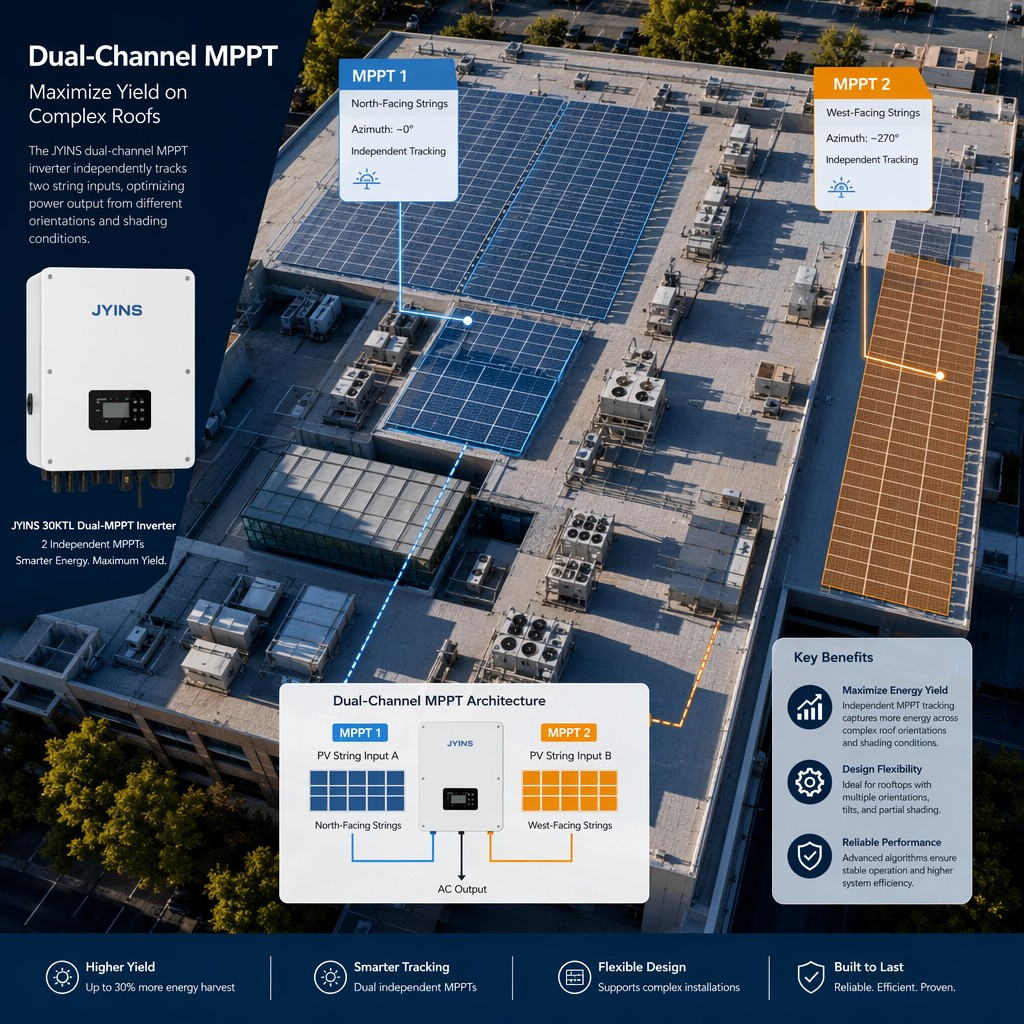
In the return on investment (ROI) calculation of B2B commercial PV projects, energy yield is the most critical variable. However, most commercial building rooftops are not flat, open spaces — they are covered with HVAC units, parapet walls, ventilation ducts, and elevator machine rooms. The partial shading created by these obstructions is the main cause of PV system efficiency loss. For procurement directors, choosing a JYINS inverter with dual-channel (or multi-channel) Maximum Power Point Tracking (MPPT) technology is a strategic decision that solves this technical bottleneck and ensures long-term project profitability. This article explains the technical logic and business value behind it.
1. Why Is Shading the Profit Killer of Commercial PV?
PV panels behave like a series of connected water pipes: if one section is blocked (shaded), the water flow through the entire pipe drops sharply. In a traditional single-channel MPPT inverter system, if 10% of a string of panels is shaded, the overall generation of the inverter system can drop by 30% or more, because the inverter cannot find a single optimal power output point for panels under different irradiance conditions.
2. Core Advantage of Dual-Channel MPPT: Divide and Conquer
JYINS industrial-grade grid-tied and hybrid inverters are typically equipped with independent dual MPPT trackers. Their working principle can be summarized as divide and conquer:
- Independent search and tracking: the inverter contains two independent DC/DC conversion circuits. Even if MPPT 1's output drops due to HVAC shading, MPPT 2 can still independently track its maximum power point under full sunlight. The two channels do not interfere with each other, ensuring that the unshaded panels always operate at full output.
- Adapting to complex orientations: commercial rooftops often span east-west. With dual-channel MPPT, the east-facing and west-facing arrays can be connected to separate channels, effectively solving the staggered output problem caused by different sun angles.
3. Three Key Technical Dimensions in Procurement Decisions
When evaluating JYINS solutions, procurement directors should focus on the following technical details that support energy yield:
1. MPPT Dynamic Tracking Efficiency
Shading is not static; it changes slowly as the sun moves. JYINS uses an advanced global scanning algorithm (Global MPPT Scanning) that can effectively identify multi-peak curves and avoid false maximum power points. This means that under cloudy conditions with rapidly moving shadows, JYINS inverters deliver 3%-5% higher yield than ordinary products.
2. Wide Voltage Operating Range
Shading causes the output voltage of a panel string to fluctuate significantly. JYINS inverters feature an extremely wide MPPT operating voltage range (e.g., 120V - 500V). Even when shading is severe and voltage drops, the inverter stays online, avoiding energy loss from premature shutdown.
3. Thermal Dissipation and Component Lifespan
When handling unbalanced loads (one channel heavily loaded, one lightly loaded), ordinary inverters may suffer uneven internal heat dissipation. JYINS has optimized the thermal design to keep power components (IGBT) within a healthy temperature range under complex unbalanced load conditions, ensuring a commercial service life of over 15 years.
4. The Business Case: Multiple ROI Benefits
- Higher installed density: with dual-channel MPPT, designers can utilize rooftop edge areas previously considered too shaded, increasing installed capacity on the same footprint.
- Lower maintenance costs: greater shading tolerance means no need for frequent rework of rooftop obstructions or fine-tuning panel repositioning, directly saving construction and ongoing maintenance costs.
- Improved financing value: banks and third-party financing institutions prefer systems using dual-channel MPPT technology because their generation stability is more predictable and cash flow performance is better.
5. Selection Tips for Procurement Directors
- Review certification reports: ask suppliers for third-party laboratory test reports of MPPT static and dynamic efficiency (such as TUV certification).
- Simulation support: JYINS provides professional plant design software simulation support for B2B customers, estimating the yield increase from dual-channel MPPT based on a 3D model of your actual rooftop.
- Consider scalability: for commercial projects that may expand in the future, the dual-channel design reserves more flexible wiring space.
6. Conclusion
In the game of commercial PV, returns often hide in the details. A dual-channel MPPT inverter is not an expensive luxury option — it is an essential tool for complex commercial environments. With superior MPPT performance and industrial-grade reliability, JYINS provides buyers with a solid, efficient investment foundation. Choosing JYINS means choosing guaranteed returns that keep chasing the light even under every inch of shadow.
Table of Contents
- Q: Procurement Director's Guide: How Do Dual-Channel MPPT Inverters Optimize Energy Yield Under Complex Commercial Roof Shading?
- A:
- 1. Why Is Shading the Profit Killer of Commercial PV?
- 2. Core Advantage of Dual-Channel MPPT: Divide and Conquer
- 3. Three Key Technical Dimensions in Procurement Decisions
- 4. The Business Case: Multiple ROI Benefits
- 5. Selection Tips for Procurement Directors
- 6. Conclusion