EN
EN


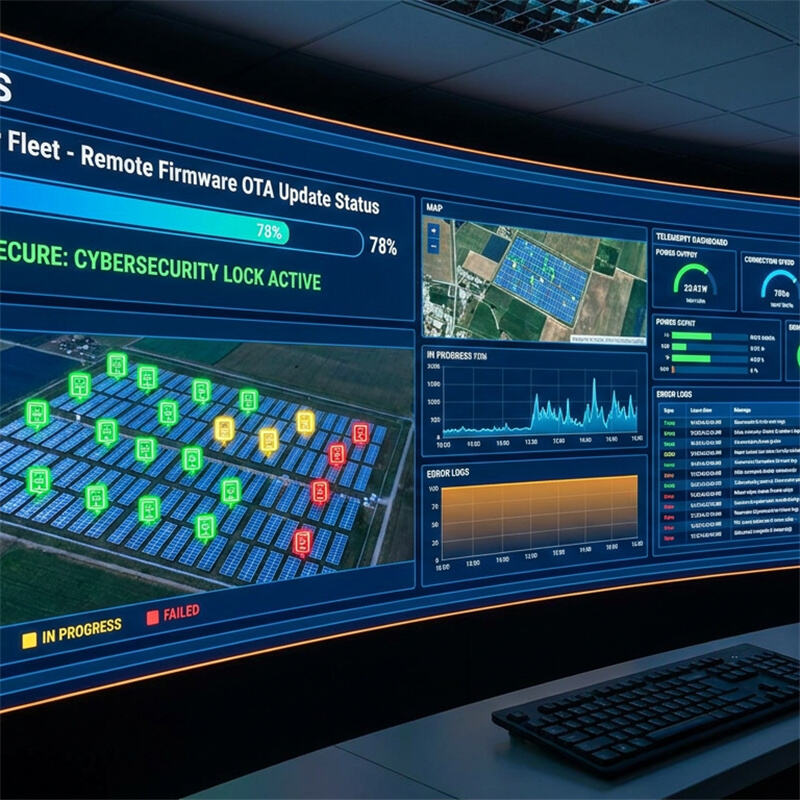
The Modern Necessity of Remote Firmware Management for Distributed Arrays
As B2B commercial solar and energy storage installations grow in scale and geographic distribution, managing these decentralized assets becomes a major operational challenge. In modern smart grids, the inverter is no longer a simple 'dumb' power converter; it is an intelligent, connected Internet of Things (IoT) edge device. Like any high-performance computer, inverters rely on complex firmware to control their power conversion algorithms, safety mechanisms (such as AFCI and RCMU), and communication protocols. Periodically, manufacturers release firmware updates to patch security vulnerabilities, optimize efficiency, add support for new battery chemistries, or comply with changing grid-connection standards. Sending technical teams to physically perform updates on hundreds of remote, scattered sites is slow and expensive. Over-the-Air (OTA) firmware updates have become an operational necessity. However, executing remote updates introduces major security and system recovery risks that B2B operators must address.
Security Architecture: Protecting OTA Firmware Updates from Cyber Threats
Connecting critical energy infrastructure to the internet exposes it to potential cyberattacks. If an unauthorized attacker gains access to an inverter's firmware, they could potentially disable safety features, damage expensive battery assets, or even inject malicious code to manipulate the local electrical grid. To prevent such catastrophic breaches, JYINS implements a multi-layered cybersecurity architecture for all OTA firmware updates:
- Cryptographic Code Signing: Every firmware image released by JYINS is cryptographically signed using private keys stored in secure, hardware-isolated servers at our headquarters. The inverter's internal microprocessor features a secure bootloader that verifies this digital signature using a public key embedded in its hardware. If the signature does not match or has been modified, the inverter will reject the update immediately, preventing the execution of unauthorized or corrupted code.
- End-to-End Encryption (AES-256): All communication between the JYINS smart cloud monitoring platform and the remote inverter is encrypted using industry-standard TLS (Transport Layer Security) with AES-256 encryption. This ensures that the firmware binary cannot be intercepted, read, or modified by third parties as it travels over public cellular or satellite networks.
- Secure Multi-Factor Authentication (MFA): To initiate an OTA firmware update, B2B fleet managers must authenticate themselves via our secure cloud portal using MFA. This ensures that only authorized engineers with verified permissions can trigger updates on the remote inverter fleet.
Redundancy and Fail-Safe Mechanisms: Implementing Dual-Image Recovery
In remote, unattended locations, the worst-case scenario during a firmware update is a 'bricked' device—an inverter that becomes completely unresponsive due to a corrupted update, a power loss, or a communication dropout mid-transmission. If this occurs, a technician must physically visit the site with specialized hardware tools to manually re-flash the microprocessor, resulting in expensive travel costs and substantial lost power production. To eliminate this risk, JYINS inverters incorporate robust dual-image flash memory architecture:
- Active and Backup Partitions: The inverter's flash memory is divided into two separate, independent storage partitions. Partition A holds the currently running 'active' firmware, while Partition B is the backup slot used to store the newly downloaded firmware image.
- Verifying Before Activating: During an OTA update, the new firmware is downloaded and saved entirely to Partition B while the inverter continues to run normally on Partition A, ensuring zero operational downtime. Once the download is complete, the bootloader performs a full cyclic redundancy check (CRC) to verify the integrity of the downloaded file. Only after the CRC succeeds does the bootloader attempt to boot from Partition B.
- Automated Rolling Back: When the inverter boots up on the new firmware (Partition B) for the first time, it performs a series of automated self-diagnostic routines to verify that all hardware systems, sensors, and communication links are operating correctly. If any critical system fails, or if the inverter fails to boot within a defined timeout period (typically 60 seconds), the bootloader automatically marks Partition B as corrupted and rolls back to the stable, working firmware on Partition A. This fail-safe loop ensures that the inverter always remains online and connected, regardless of download failures.
Step-by-Step Procedure for Executing Site-Wide OTA Fleet Updates
For B2B operations managers overseeing large fleets of solar inverters, executing site-wide updates should follow a strict, phased engineering procedure to minimize operational risks:
- Phase 1: Pre-Update Diagnostics and Baseline Testing. Before triggering any updates, review the fleet's current operating status via the JYINS cloud monitoring portal. Ensure that all targeted inverters are online, stable, and showing no active hardware faults. Verify that local internet connectivity is stable and has sufficient signal strength.
- Phase 2: Pilot Testing (The 'Canary' Release). Select a single, easily accessible inverter as a 'canary' test device. Apply the new firmware to this unit and monitor its performance closely for 48 to 72 hours. Check for any unexpected changes in efficiency, thermal performance, or communications stability.
- Phase 3: Phased Rollout. Group the remaining inverters into smaller batches (e.g., 10 percent of the fleet at a time). Schedule the updates to run during non-production hours, such as at night when solar inverters are idle, to minimize any impact on daily power generation. Monitor the progress of each batch before moving to the next.
- Phase 4: Post-Update Validation. Once the entire fleet is updated, compare post-update performance data against the baseline data collected in Phase 1 to verify that the updates have successfully delivered the expected optimizations or security improvements.
Troubleshooting Failed Transmissions and Communication Blackouts
In remote areas, wireless cellular or satellite communication can be highly unstable. If a connection drops during a firmware download, the JYINS cloud monitoring platform automatically handles the recovery process:
- Resuming Downloads: Our communication protocols support segmented file transfers. If a download is interrupted, the inverter will retain the partially downloaded file and resume from where it left off once the connection is restored, preventing unnecessary data usage and reducing download times.
- Alert System: If an inverter remains offline or fails to complete an update after multiple attempts, the cloud platform will flag the device and send an email alert to the system administrator, allowing them to troubleshoot the local network without interrupting the rest of the fleet update.
JYINS Smart Cloud Connectivity: Secure, Reliable, and Resilient
JYINS is dedicated to manufacturing power conversion equipment that pairs industry-leading power electronics with high-security digital technologies. Our smart cloud monitoring and management platform is designed specifically to help B2B operators manage their distributed power assets with ease, security, and total peace of mind.
By choosing JYINS inverters with built-in OTA security and dual-image fail-safe recovery, you are investing in a future-proof power infrastructure that can be updated, optimized, and secured remotely without risk or hassle. Our B2B engineering and cybersecurity support teams are always available to help our partners plan and execute fleet-wide updates, ensuring their systems remain highly secure, fully compliant, and productive for years to come.
Table of Contents
- The Modern Necessity of Remote Firmware Management for Distributed Arrays
- Security Architecture: Protecting OTA Firmware Updates from Cyber Threats
- Redundancy and Fail-Safe Mechanisms: Implementing Dual-Image Recovery
- Step-by-Step Procedure for Executing Site-Wide OTA Fleet Updates
- Troubleshooting Failed Transmissions and Communication Blackouts
- JYINS Smart Cloud Connectivity: Secure, Reliable, and Resilient