EN
EN


Introduction: The Rise of V2H in Residential Microgrid Architectures
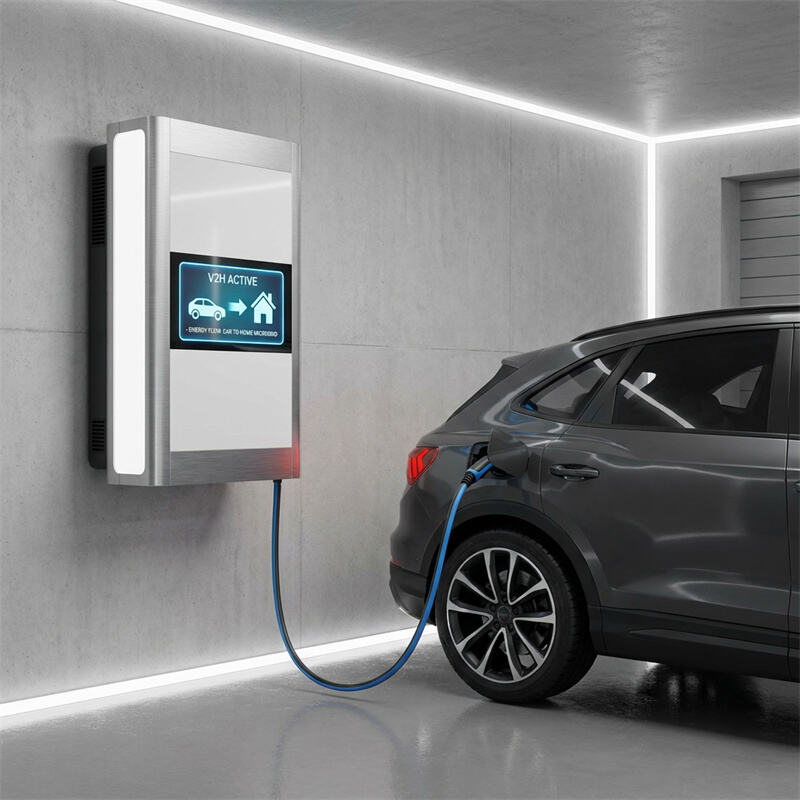
In the rapidly evolving landscape of residential energy management, future-tech architects and B2B housing project developers are moving beyond simple solar photovoltaic installations. Today, the focus is on creating true decentralized microgrids that maximize self-consumption, provide backup power during grid outages, and stabilize local distribution networks. At the heart of this transition is Vehicle-to-Home (V2H) technology. This system allows the massive battery pack of an electric vehicle (EV) to serve as a primary energy storage system for the home.
While the concept is simple, the engineering required to implement V2H is highly complex. It demands sophisticated power electronics capable of managing bidirectional power flow with high efficiency, absolute safety, and millisecond-level responsiveness. For developers sourcing equipment for premium sustainable housing developments, understanding the engineering behind bidirectional inverters is essential to ensuring long-term system reliability and investment protection.
Q: What are the primary engineering challenges when designing bidirectional V2H inverters for residential microgrids, and how are they solved?
Answer:
Designing bidirectional V2H inverters requires solving several major engineering challenges. These include implementing efficient dual-way power conversion topologies, establishing robust grid-forming and synchronization controls, ensuring absolute safety and galvanic isolation, and integrating complex automotive and home communication protocols.
Modern engineers solve these challenges by utilizing advanced silicon carbide (SiC) semiconductors, implementing digital signal processor (DSP) closed-loop control algorithms, incorporating high-frequency isolated transformers, and adhering to open-standards-based communication protocols. These technologies allow the inverter to transition seamlessly between charging the EV battery from the residential solar array and discharging the EV battery to power home appliances, all while maintaining perfect power quality.
Technical Challenge 1: Bidirectional Topology and Active Front End
Traditional EV chargers and residential inverters are designed for unidirectional power flow. In contrast, a V2H inverter must handle power moving in both directions. This requires a complete redesign of the power electronics stage.
- The Dual Active Bridge (DAB) Stage: To manage the DC-DC conversion between the variable voltage of the EV battery (typically 350V to 800V) and the internal DC link of the inverter, engineers utilize a Dual Active Bridge topology. This active bridge uses high-speed semiconductor switches on both sides of a high-frequency isolation transformer. By controlling the phase shift between the two bridges, the direction and rate of power transfer can be regulated with extreme precision.
- Silicon Carbide (SiC) Benefits: Traditional silicon MOSFETs or IGBTs suffer from significant switching losses at high frequencies. By upgrading to Silicon Carbide (SiC) power modules, JYINS engineers minimize these losses, enabling the inverter to operate at switching frequencies above 100 kHz. This high-frequency operation reduces the physical size of inductors and capacitors, resulting in a more compact, light, and power-dense inverter housing.
- Active Front End (AFE) Stage: For the DC-AC conversion stage, a bidirectional Active Front End is implemented. The AFE acts as a rectifier when charging the vehicle and as an inverter when discharging back to the home. This dual-purpose stage utilizes advanced pulse-width modulation (PWM) to maintain a near-unity power factor and keep total harmonic distortion (THD) below 3 percent, which is critical for protecting sensitive home electronics.
Technical Challenge 2: Grid-Forming vs. Grid-Following Controls
A residential microgrid can operate in two primary states: grid-connected (parallel) and islanded (standalone). The V2H inverter must adapt its control scheme depending on this state.
- Grid-Following Mode: When the utility grid is stable, the V2H inverter operates in grid-following mode. It locks onto the grid voltage and frequency using a Phase-Locked Loop (PLL) algorithm and injects or withdraws current in perfect phase with the grid. This allows the system to offset local household loads or export excess power back to the utility.
- Grid-Forming Mode: During a utility grid failure, the inverter must instantly switch to grid-forming mode. In this mode, the inverter acts as a voltage source, establishing its own local voltage and frequency reference. It must handle sudden, heavy household load changes without experiencing voltage dips or frequency deviations. Advanced droop control algorithms are programmed into the inverter's microcontroller to simulate the physical inertia of traditional generators, ensuring the microgrid remains stable under dynamic loads.
Technical Challenge 3: Safety, Galvanic Isolation, and Compliance
Safety is the absolute priority in residential electrical installations. Connecting a high-voltage automotive battery to a residential distribution board introduces significant electrical safety risks.
- Galvanic Isolation: A fundamental requirement for residential safety is galvanic isolation between the EV battery circuit and the AC home grid. This is achieved using a high-frequency planar transformer within the DC-DC converter stage. This transformer ensures that there is no direct electrical path between the high-voltage DC bus of the vehicle and the AC domestic wiring, preventing catastrophic faults from propagating.
- Anti-Islanding Protection: When the utility grid goes down for maintenance, the V2H inverter must absolutely prevent backfeeding power into the public lines. Backfeeding poses a lethal risk to utility line workers. Engineers implement redundant passive and active anti-islanding detection methods. Redundant sensors monitor grid impedance, frequency shift, and rate of change of frequency (ROCOF) to disconnect the inverter from the utility grid within 100 milliseconds of an outage, switching the residential microgrid to isolated backup mode.
Technical Challenge 4: Communication Protocol Integration
A V2H system represents the convergence of two distinct industries: automotive and residential power. The inverter must communicate simultaneously with both systems.
- Automotive Communication: The inverter communicates with the EV using the ISO 15118-20 protocol (the latest international standard for Vehicle-to-Grid and Vehicle-to-Home). This protocol enables secure, high-speed digital communications over the charging cable, exchanging critical metrics such as battery State of Charge (SOC), maximum allowable discharge current, and battery cell temperatures.
- Home Energy Management (HEMS) Communication: On the residential side, the inverter must communicate with the Home Energy Management System and smart meters. This is typically done via Modbus TCP, Wi-Fi, or Zigbee protocols. By receiving real-time data from the household smart meter, the inverter adjusts its output to match the immediate electrical demand, ensuring that no power is accidentally exported to the grid when operating in self-consumption mode.
Sourcing Reliable V2H Solutions with JYINS Electrical
For B2B buyers, sourcing V2H-compatible power electronics means looking for partners who combine technical depth with robust manufacturing standards. At JYINS Electrical, we apply our decades of experience in high-efficiency power electronics to design components that meet the rigorous demands of modern residential microgrids. Our engineering philosophy centers on three core pillars:
- Thermal Management: High-power bidirectional operation generates significant heat. JYINS utilizes advanced aluminum alloy heatsinks and intelligent, variable-speed fan cooling networks to keep internal component temperatures low, significantly extending the service life of critical capacitors and semiconductor switches.
- Component-Level Redundancy: We source premium-grade capacitors, magnetic cores, and SiC power modules to ensure our units operate reliably under continuous full-load conditions.
- Global Certifications: All JYINS products are developed to meet and exceed international safety and compliance certifications, providing our B2B partners with complete peace of mind during local system verification.
Conclusion: Sourcing the Future of Residential Energy
Bidirectional V2H inverters represent a milestone in the evolution of residential energy independence. By effectively transforming electric vehicles into mobile energy storage systems, project developers can deliver residential microgrids with unprecedented resilience and economic efficiency. When sourcing these advanced systems, focusing on the underlying engineering, dual-stage isolated topologies, grid-forming capabilities, and strict safety protocols is key to project success. Partnering with a dedicated manufacturer like JYINS Electrical ensures your projects are powered by cutting-edge, field-tested technology designed for the energy demands of tomorrow.
Table of Contents
- Introduction: The Rise of V2H in Residential Microgrid Architectures
- Q: What are the primary engineering challenges when designing bidirectional V2H inverters for residential microgrids, and how are they solved?
- Answer:
- Technical Challenge 1: Bidirectional Topology and Active Front End
- Technical Challenge 2: Grid-Forming vs. Grid-Following Controls
- Technical Challenge 3: Safety, Galvanic Isolation, and Compliance
- Technical Challenge 4: Communication Protocol Integration
- Sourcing Reliable V2H Solutions with JYINS Electrical
- Conclusion: Sourcing the Future of Residential Energy