EN
EN


Introduction to Off-Grid Industrial Microgrids
Industrial and B2B facilities operating in off-grid environments require highly reliable power systems. Relying solely on solar photovoltaic (PV) arrays and battery storage can pose risks during extended periods of low irradiance or during peak high-torque machinery startups. To address these vulnerabilities, backup diesel generators are commonly integrated into off-grid microgrids. However, combining a static power converter like an off-grid inverter with a rotating mechanical generator presents unique technical challenges.
This technical QA article explores the physics and engineering strategies required to successfully synchronize a JYINS off-grid inverter with a backup diesel generator, ensuring seamless power transfer and preventing system failures.
Question: How to synchronize an Off-Grid Inverter with a Backup Diesel Generator for seamless industrial power?
To achieve a reliable and seamless synchronization between an off-grid inverter and a backup diesel generator, engineers must implement a multi-layered coordination system. This system involves active phase synchronization, voltage window alignment, dry-contact automation, and smart battery charging current limits. Below is a detailed breakdown of the technical challenges, synchronization mechanisms, and step-by-step configuration guidelines.
The Technical Challenges of Dual-Source Integration
Integrating a static inverter with an engine-driven generator is not as simple as wiring their outputs together. There are three primary physical and electrical barriers that must be addressed:
- Phase and Frequency Disparity: When the diesel generator starts, its alternator rotates at a speed governed by its mechanical fuel injection system. This speed dictates the output frequency (e.g., 50 Hz or 60 Hz). The inverter is also generating its own AC reference sine wave. If the two sources are connected while out of phase, a massive short-circuit current will flow between them, destroying the inverter's output MOSFETs and potentially damaging the generator's windings.
- Reverse Power Flow and Generator Motoring: Static inverters are designed to feed power to loads. If the battery bank is fully charged and solar production is high, the inverter may attempt to export power. If connected to a generator, this power is fed back into the generator's alternator, causing the generator to act as a synchronous motor. This can lead to mechanical engine damage or trigger generator over-frequency alarms.
- Voltage Step Response and Governor Lag: Diesel generators have mechanical governors that adjust fuel injection in response to load changes. When a heavy load is switched from the inverter to the generator, the generator's engine speed (and thus its output frequency and voltage) will temporarily dip before recovering. The inverter's phase-tracking software must handle these transient variations without dropping the load or disconnecting.
Phase-Locked Loops and Active Synchronization
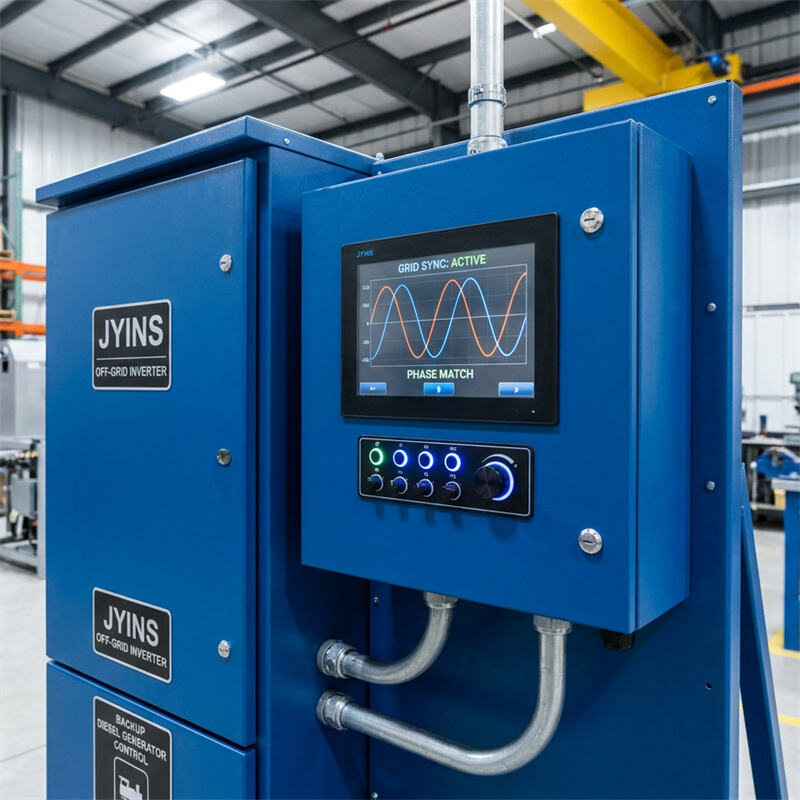
To safely bridge the two sources, high-performance inverters like the JYINS Industrial Series utilize a Phase-Locked Loop (PLL) algorithm in their control firmware.
When the diesel generator is running and its output is detected at the inverter's AC-input terminals, the inverter does not immediately close the bypass relay. Instead, the PLL actively tracks the voltage waveform of the generator.
The inverter's internal microprocessor measures the zero-crossing points of the generator's AC voltage. It then dynamically adjusts the phase angle and frequency of the inverter's own AC output to match the generator. This process is called phase alignment.
Once the phase angle difference between the inverter and the generator is close to zero degrees, and the voltage and frequency are within the configured tolerance windows, the inverter closes its internal transfer relay. Because the two sine waves are perfectly aligned, the transition occurs without any voltage interruption, phase jump, or current spike. This ensures that sensitive PLC controllers, industrial computers, and laboratory instruments continue operating without rebooting.
Control Automation: Dry-Contact Wiring and AGS
Seamless operation requires automatic starting and stopping of the generator based on the energy storage system's state. This is handled by the Automatic Generator Start (AGS) function.
Most JYINS off-grid inverters are equipped with an onboard dry-contact relay. This relay acts as a smart switch connected to the remote start terminals of the diesel generator's digital controller (such as a Deep Sea or ComAp controller).
- Low Voltage or Low SoC Trigger: When the battery bank's voltage drops below a pre-set threshold (e.g., 46V for a 48V nominal system) or the battery State of Charge (SoC) falls below 20%, the inverter closes the AGS dry contact. This sends a run signal to the generator controller.
- Warm-Up Delay: The generator controller initiates the engine starting sequence, allows the diesel engine to crank, and runs it for a pre-set warm-up delay (typically 30 to 60 seconds) to stabilize engine temperature and oil pressure.
- Synchronization and Loading: Once the generator reaches its rated speed and output voltage, the JYINS inverter detects the AC input, synchronizes its phase using the PLL, and then switches the load from the inverter to the generator.
- Cool-Down and Shut-Down: When the solar PV system has recharged the batteries to a safe level (e.g., 90% SoC or 54V) and the load demand decreases, the inverter opens the AGS dry contact. The generator controller then enters a cool-down period (usually 2 to 3 minutes of no-load operation) before stopping the engine completely. This preserves engine life and prevents thermal shock.
Preventing Generator Overload: Smart Charging Current Limits
One of the most common causes of system failure during synchronization is generator stalling. When the inverter bypasses to the generator, it often attempts to do two things simultaneously: support the building's AC loads and recharge the battery bank at maximum current.
If a 5kW JYINS inverter is connected to a 6kW generator, and the building is drawing 4kW of load, the inverter's battery charger might attempt to draw an additional 3kW to charge the batteries. This demands 7kW from a 6kW generator, causing the engine speed to drop, voltage to sag, and the generator's circuit breaker to trip.
To resolve this, JYINS inverters allow engineers to configure two critical parameters:
- AC Input Current Limit: This setting tells the inverter the maximum total current it is allowed to draw from the generator. If the generator is rated for 25A, the inverter can be configured to limit its AC draw to 20A (applying an 80% safety margin).
- Dynamic Charger Power Reduction: If the AC load increases, the inverter will automatically reduce its battery charging current to ensure the total current drawn from the generator never exceeds the configured AC input current limit. This prioritizes active loads while protecting the generator from overload.
Sizing and Slew Rate Calibration Guidelines
For optimal performance in B2B systems, engineers should follow these sizing and calibration principles:
- Sizing Ratio: The nominal continuous rating of the diesel generator should be at least 1.5 to 2 times the nominal rating of the off-grid inverter. For a 10kW inverter system, a generator of at least 15kVA is recommended. This provides sufficient head-room for both heavy load support and battery charging.
- Slew Rate Tuning: The slew rate is the speed at which the inverter's PLL can change its output frequency to track the generator. In systems with unstable mechanical governors, the generator's frequency may drift rapidly. If the slew rate is set too low, the inverter will struggle to lock phases and may reject the generator input. If set too high, the rapid frequency shifts can disrupt sensitive downstream equipment. JYINS inverters allow fine-tuning of the PLL tracking speed to match specific generator qualities.
- Voltage and Frequency Tolerance Windows: Set the inverter's AC-input voltage window to 'Generator Mode'. This widens the acceptable voltage range (e.g., 180V to 270V) and frequency range (e.g., 45 Hz to 65 Hz) to accommodate transient governor sags during heavy motor startups without causing nuisance disconnections.
Conclusion
Synchronizing an off-grid inverter with a backup diesel generator is a highly effective way to achieve true utility-grade reliability in remote industrial workshops, marine setups, and telecom hubs. By utilizing JYINS' active PLL phase synchronization, configuring robust AGS parameters, and setting smart charger current limits, engineers can prevent reverse power flow, protect valuable engine assets, and guarantee uninterrupted power to critical B2B operations. Selecting the correct sizing ratios and fine-tuning frequency tolerances are the final steps to engineering a resilient, automated off-grid power solution.
Table of Contents
- Introduction to Off-Grid Industrial Microgrids
- Question: How to synchronize an Off-Grid Inverter with a Backup Diesel Generator for seamless industrial power?
- The Technical Challenges of Dual-Source Integration
- Phase-Locked Loops and Active Synchronization
- Control Automation: Dry-Contact Wiring and AGS
- Preventing Generator Overload: Smart Charging Current Limits
- Sizing and Slew Rate Calibration Guidelines
- Conclusion