EN
EN


Q: How can you mitigate the impact of magnetostriction (transformer hum) on the acoustic reliability of inverters installed in quiet zones?
A:
In off-grid power systems serving schools, hospitals, libraries, or high-end residential neighborhoods, inverter operating noise is often a key quality criterion. Many B2B buyers find that even high-quality sine wave inverters emit a continuous, low-frequency "hum" under load. The core physical source of this noise is called "magnetostriction." Through in-depth acoustic engineering, the JYINS R&D team has developed a systematic solution for quiet-zone applications, ensuring that the inverter delivers efficient power while maintaining a high level of acoustic reliability.
1. Magnetostriction: The Physical Root of the Hum
Magnetostriction is the phenomenon in which ferromagnetic materials (such as the silicon steel core of a transformer) undergo slight dimensional changes under the influence of a magnetic field. When alternating current flows through the transformer windings, the magnetic field reverses direction 100 times per second (at 50Hz), causing the core to expand and contract repeatedly. This high-frequency vibration propagates through the air and structural parts, producing the hum we hear at 100Hz and its multiples. Under heavy loads or in the presence of current harmonics, this vibration becomes significantly more intense.
2. JYINS Inverters' Noise Reduction and Reliability Design
For B2B scenarios that are extremely sensitive to noise, JYINS has incorporated the following four core technologies into its product design:
- 1. High-quality silicon steel laminations and flux density control
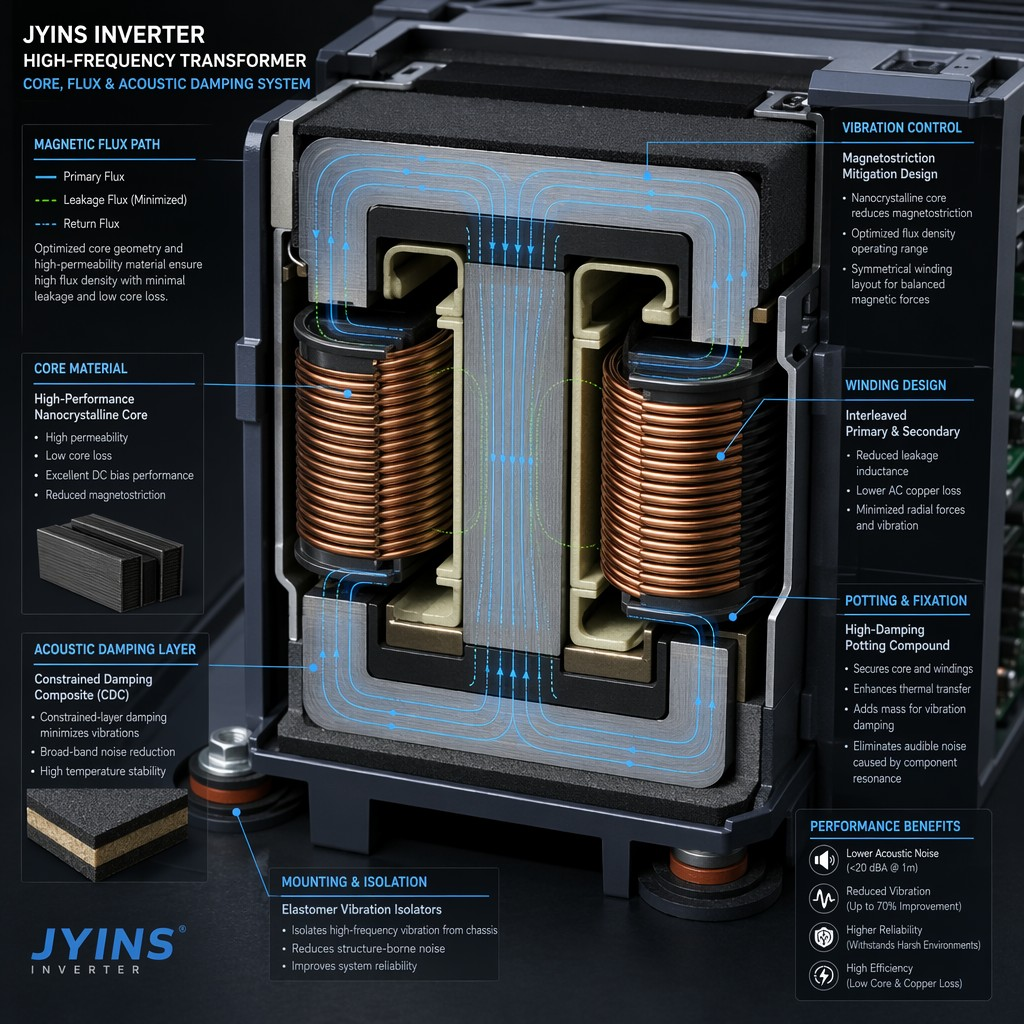
JYINS uses grain-oriented silicon steel laminations with an extremely low magnetostriction coefficient and optimizes the transformer's flux density design. By appropriately reducing the rated operating flux density, the core's deformation under strong magnetic fields is minimized, reducing vibration energy at the source.
- 2. Vacuum pressure impregnation (VPI) process
This is the key to eliminating noise caused by loose cores and windings. During manufacturing, JYINS transformers undergo vacuum pressure impregnation, allowing the insulating varnish to fully penetrate the gaps between silicon steel laminations. Once cured, the varnish bonds the core into a solid whole, effectively suppressing micro-mechanical vibration between laminations while also enhancing the equipment's moisture resistance and insulation performance.
- 3. Suspended vibration damping and damping structures
Inside the inverter, the transformer is not fixed directly to the chassis. Instead, it is mounted on specially designed rubber damping pads. This "structural isolation" design absorbs the majority of mechanical vibration and prevents the chassis from resonating — in other words, it keeps the enclosure from becoming a giant loudspeaker.
- 4. Harmonic suppression and smooth control
Because harmonic currents intensify the multi-frequency vibration caused by magnetostriction, JYINS inverters use their SPWM (sinusoidal pulse width modulation) algorithm to output extremely smooth voltage waveforms. A purer fundamental current helps reduce nonlinear mechanical stress inside the transformer, thereby lowering noise.
3. On-Site Installation Tips for Acoustic Optimization
Besides the equipment's own quality, the way it is installed on site has a huge impact on the final acoustic experience:
- Choose the right mounting surface: In quiet zones, avoid mounting the inverter directly on hollow wooden walls or thin metal panels, which easily resonate and amplify noise. Install it on solid brick or concrete walls instead.
- Resilient supports: In B2B project delivery, we recommend adding extra butyl rubber pads at the inverter's mounting hooks to further break the vibration transmission path.
- Spatial acoustic isolation: If possible, install the inverter in a well-ventilated, dedicated equipment room. For applications that must be installed indoors, JYINS offers a dedicated low-noise series whose acoustic performance exceeds industrial standards by more than 15dB.
4. The Long-Term Significance of Acoustic Reliability
For B2B customers, low noise is not just about comfort — it is a reflection of equipment service life. Continuous, severe vibration can cause transformer winding wear, solder joint fatigue, and micro-cracks in electronic components. JYINS' quiet design is, at its core, a high-reliability design that ensures the inverter will not fail due to mechanical fatigue over a service life of more than 10 years.
5. Conclusion
Although magnetostriction is an inherent physical property of transformers, JYINS' precision engineering can reduce its impact to a level that is virtually imperceptible to the human ear. Through a combination of material selection, process control, and structural damping, JYINS provides an ideal power core for quiet-zone applications that balances efficiency and silence. For contractors who pursue excellence in project delivery, a deep understanding of these acoustic details will help improve overall acceptance satisfaction.
Table of Contents
- Q: How can you mitigate the impact of magnetostriction (transformer hum) on the acoustic reliability of inverters installed in quiet zones?
- A:
- 1. Magnetostriction: The Physical Root of the Hum
- 2. JYINS Inverters' Noise Reduction and Reliability Design
- 3. On-Site Installation Tips for Acoustic Optimization
- 4. The Long-Term Significance of Acoustic Reliability
- 5. Conclusion