EN
EN


Q: Designing power conversion for Electric Forklift Charging Stations in large distribution centers.
Introduction: The Electrification of Logistics Infrastructure
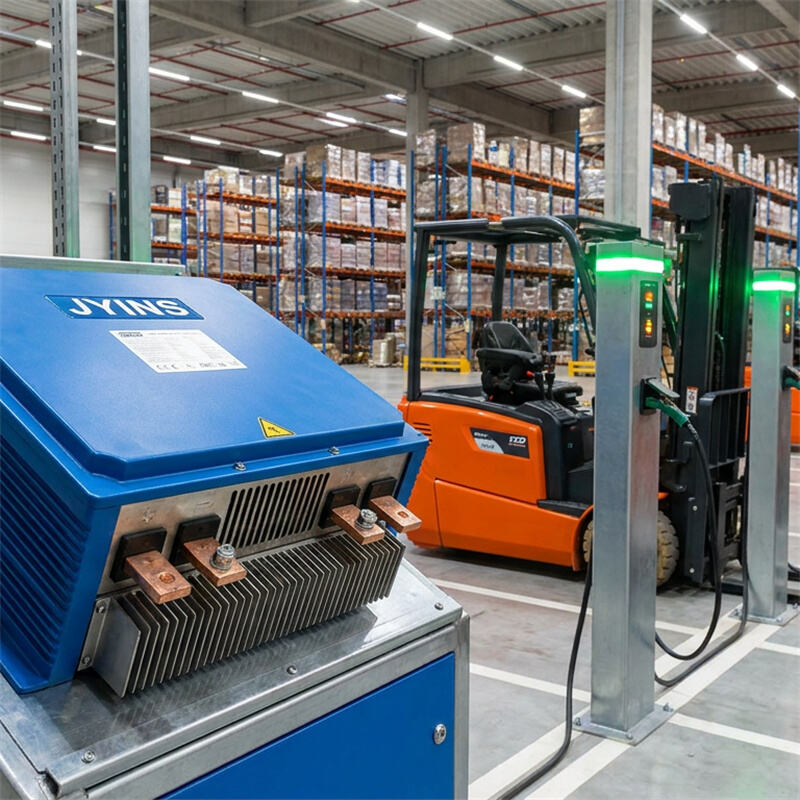
In modern supply chain management, large-scale distribution centers and logistics hubs operate around the clock to meet demanding delivery schedules. To maximize operational efficiency and comply with carbon-neutral initiatives, these facilities have rapidly transitioned their material handling fleets from diesel or liquefied petroleum gas to electric power. Today, hundreds of electric forklifts, reach trucks, and automated guided vehicles scurry across warehouse floors, powered by high-capacity lithium-ion or lead-acid battery packs.
However, this massive fleet electrification introduces a major engineering challenge: the design of the power conversion and charging infrastructure. A charging station for a fleet of electric forklifts is not a simple electrical plug. It is a highly demanding power electronics installation. It must convert grid-level alternating current into highly regulated direct current to charge various battery chemistries, all while managing severe load fluctuations, thermal stress, and power quality constraints.
For facility managers, electrical engineers, and logistics project leads, designing an efficient power conversion system for forklift charging stations requires a deep understanding of industrial power electronics. This comprehensive guide details the key technical challenges and design requirements, highlighting how JYINS Electrical high-performance industrial power solutions can be integrated into large-scale logistics operations.
Technical Challenges in Forklift Charger Power Conversion
Designing power conversion systems for forklift charging bays in a distribution center is uniquely challenging due to several harsh operational realities:
- Severe Grid Loading and Fluctuations: When multiple high-power fast chargers are activated simultaneously, they draw massive amounts of current. This concentrated load can cause localized voltage sags, phase imbalances, and electrical noise across the distribution center's electrical network.
- Harsh Environmental Conditions: Distribution center charging bays are often situated in non-climate-controlled zones. They are exposed to high levels of airborne dust, physical vibrations from passing vehicles, and wide temperature swings, which can severely impact the lifespan of standard commercial chargers.
- Diverse Battery Chemistries: Modern fleets often utilize a mix of legacy flooded lead-acid batteries, thin plate pure lead batteries, and advanced lithium-ion packs. Each chemistry requires a highly specific charging profile, with different voltage and current regulation requirements during the bulk, absorption, and float stages.
- Power Factor and Harmonic Issues: Traditional non-linear charging loads can introduce massive harmonic currents back into the utility grid, resulting in a poor power factor. This leads to high energy utility penalties and places extra stress on transformers and distribution switchgear.
Key Design Requirements for High-Performance Power Conversion
To overcome these obstacles and ensure continuous facility uptime, engineers must design the power conversion architecture with the following parameters:
1. Active Power Factor Correction and Harmonic Mitigation
Modern forklift charging systems must incorporate active Power Factor Correction circuits at the AC-DC input stage. This design requirement ensures that the input current remains in phase with the input voltage, achieving a power factor of 0.99 or better. Additionally, the design must limit Total Harmonic Distortion of the input current to less than 5 percent. Utilizing multi-pulse rectification or active front-end topologies protects the distribution center's internal transformers from overheating and avoids costly power quality penalties from utility providers.
2. High-Efficiency Topology: LLC Resonant Converters
Because forklift chargers operate at high power levels for hours on end, thermal dissipation is a major design consideration. Standard hard-switching topologies suffer from high switching losses, resulting in efficiencies of only 82 to 85 percent. This wasted energy translates into massive heat generation, which requires expensive cooling systems.
Industrial power conversion designs must utilize high-frequency soft-switching topologies, such as LLC resonant converters. By enabling zero-voltage switching and zero-current switching, these converters can operate at efficiencies exceeding 93 percent. This minimizes heat generation, allowing for more compact charger designs and significantly reducing the overall cooling demand of the charging station room. JYINS industrial power converters leverage these advanced topologies to deliver maximum energy density and thermal efficiency.
3. Advanced BMS Communication and Dynamic Voltage Regulation
To charge modern lithium-ion forklift batteries safely and quickly, the power conversion unit must communicate in real time with the battery's internal Battery Management System.
The charging system must feature rugged industrial communication ports, such as CAN bus or RS485 interfaces. Through these communication links, the BMS constantly sends real-time voltage, current, and temperature parameters. The power conversion stage must be capable of dynamically adjusting its output voltage and current within milliseconds in response to these BMS commands. This closed-loop control prevents thermal runaway, optimizes charging speed, and extends the active life of expensive battery packs.
4. Rugged Industrial Construction and Environmental Protection
Given the dusty, high-vibration environment of a busy logistics center, charging units must be designed with industrial-grade mechanical protection. Conformal coating must be applied to all internal printed circuit boards to prevent conductive dust accumulation from causing short circuits. Heavy-duty aluminum heatsinks and intelligent, temperature-controlled cooling fans with dust filtration are necessary to maintain optimal internal operating temperatures. JYINS power conversion modules are engineered with these exact protective measures, ensuring decades of reliable operation under continuous heavy-duty cycles.
Designing a Scalable charging Bay Architecture
When designing the power conversion system for a large facility, modularity and scalability are critical:
- Modular Power Blocks: Rather than using a single, massive, non-redundant power converter for the entire charging station, engineers should design the station using multiple modular power conversion blocks connected in parallel. If one module requires maintenance, the remaining modules can continue to operate, ensuring the charging station never experiences complete downtime.
- Dynamic Power Allocation: Implement a smart power distribution system that dynamically allocates power among charging bays. For example, if a forklift with a nearly depleted battery requires a rapid charge, the system can temporarily divert more power modules to that bay, while reducing power to vehicles that are already near full charge.
- Integrated DC Bus Systems: For large-scale installations, consider designing a centralized AC-to-DC power conversion room that feeds a high-voltage DC distribution bus throughout the charging bays. This eliminates the need for individual AC-DC converters at every charging dock, simplifying maintenance, reducing overall installation costs, and allowing for easy integration of local solar arrays or battery energy storage systems.
Conclusion: Empowering Logistics with JYINS Technology
As distribution centers continue to grow in size and level of automation, the reliability of the electric forklift fleet becomes directly tied to the facility's overall productivity. A poorly designed power conversion system will lead to slow charging cycles, battery damage, high utility costs, and frequent system failures.
By integrating JYINS Electrical industrial-grade power conversion technology, logistics facility planners can build charging stations that are highly efficient, grid-friendly, and ruggedly reliable. JYINS solutions provide the precise voltage regulation, high power factor, and smart BMS communication interfaces required to keep your material handling fleet running at peak performance. Partner with JYINS to power the future of your supply chain.
Table of Contents
- Introduction: The Electrification of Logistics Infrastructure
- Technical Challenges in Forklift Charger Power Conversion
- Key Design Requirements for High-Performance Power Conversion
- 1. Active Power Factor Correction and Harmonic Mitigation
- 2. High-Efficiency Topology: LLC Resonant Converters
- 3. Advanced BMS Communication and Dynamic Voltage Regulation
- 4. Rugged Industrial Construction and Environmental Protection
- Designing a Scalable charging Bay Architecture
- Conclusion: Empowering Logistics with JYINS Technology