EN
EN


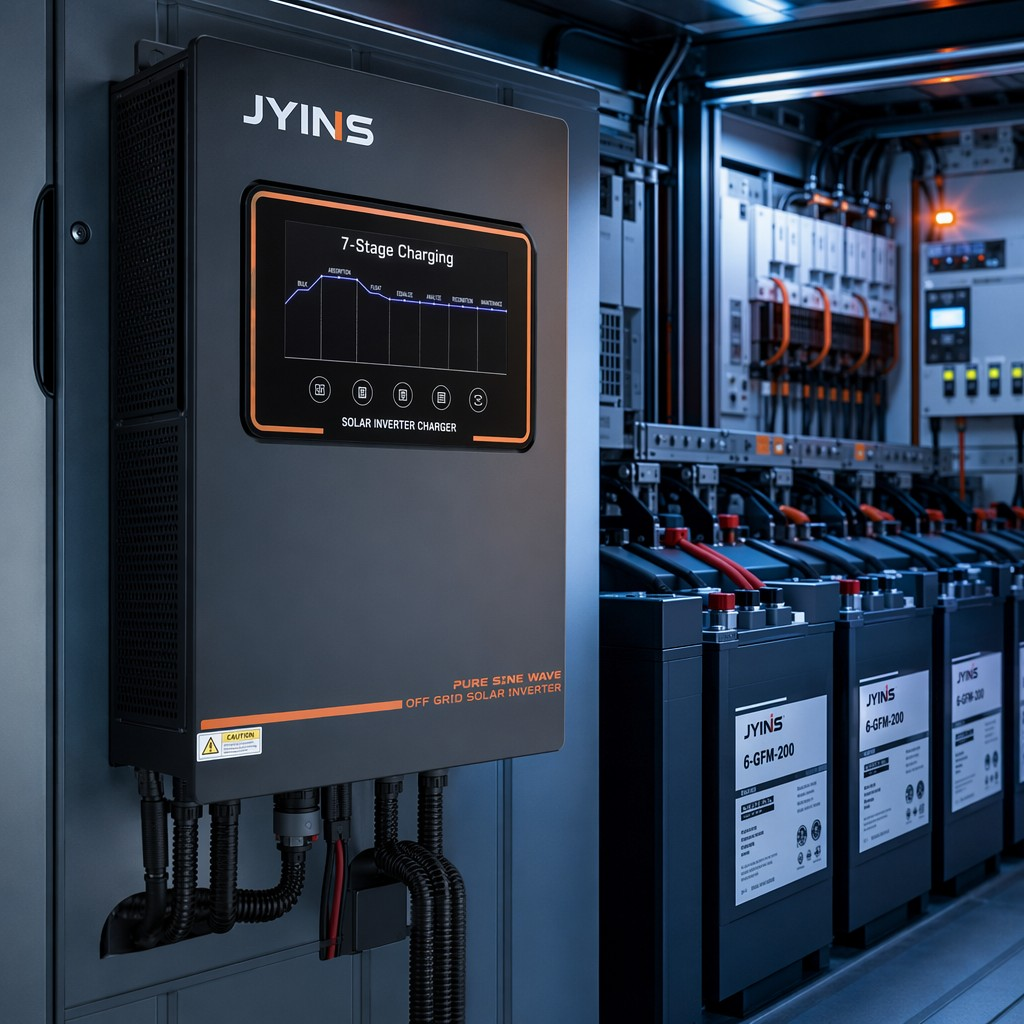
Q: How Does the JYINS Smart 7-Stage Charging Algorithm Prevent Battery Sulfation in Off-Grid Lead-Acid Battery Systems?
A:
In off-grid solar power systems, the health of lead-acid batteries (including AGM and GEL types) directly determines the operating cost and service life of the entire system. For engineers and distributors in the B2B space, battery sulfation is the number one killer behind premature battery failure. To address this industrial pain point, JYINS (Hisolar) has integrated a core technology into its high-performance sine wave inverters and charge controllers: the smart 7-stage charging algorithm. This article takes an in-depth look at how this algorithm proactively detects and suppresses sulfation through precise current and voltage control, keeping your battery bank in optimal energy storage condition over the long term.
1. Understanding the Battery Sulfation Crisis in Lead-Acid Batteries
Battery sulfation occurs when, during discharge, the sulfuric acid in the electrolyte combines with the lead on the plates to form lead sulfate crystals. In normal cycling, these crystals are fine and reversible, and they convert back to lead and sulfuric acid during charging. However, the problem becomes serious under the following conditions:
- Undercharging: Insufficient solar generation leaves the battery chronically undercharged.
- Prolonged idle periods: During off-grid downtime, the battery self-discharges and lead sulfate gradually hardens on the plate surfaces.
- Deep over-discharge: Discharge depth exceeds the limits, producing overly dense crystals.
Over time, fine lead sulfate converts into hard, coarse-grained lead sulfate deposits. These crystals not only reduce the effective reaction area of the plates, but also increase internal resistance, so the battery can no longer accept or deliver charge and eventually fails completely. For B2B customers, this means costly asset depreciation and frequent on-site maintenance visits.
2. Full-Process Protection from the JYINS Smart 7-Stage Charging Algorithm
The JYINS 7-stage charging algorithm is more than just a segmented charging process. It is a closed-loop battery inspection and restoration system. Here is how each stage works together to combat sulfation:
- 1. Desulphation
This is the first line of defense against sulfation. When the JYINS controller detects abnormally low battery voltage or excessively high internal resistance, it automatically initiates desulphation pulses. High-frequency voltage pulses break up the lead sulfate crystals already formed on the plate surface, redissolving them into the electrolyte. This process is critical for recovering batteries that are mildly sulfated after long-term storage.
- 2. Soft Start
Before aggressive charging begins, the system limits the initial charging current. This prevents sulfated batteries, which have high internal resistance, from generating excessive heat early in the charge cycle, protects the plates from deformation, and lays the physical groundwork for the high-current charging that follows.
- 3. Bulk Charge
This is the main charging stage, typically delivering about 80% of the total charge capacity. The JYINS smart algorithm outputs the maximum rated current based on real-time ambient temperature, working with the temperature compensation probe, to raise the battery voltage quickly and prevent the deposition of new lead sulfate crystals caused by overly slow charging.
- 4. Absorption
Once the voltage reaches the absorption threshold, the current tapers off while the voltage remains constant. This stage ensures that active material deep inside the plates fully participates in the chemical reaction, completely converting residual lead sulfate. The JYINS dynamic timer automatically adjusts the absorption duration based on the length of the bulk phase, preventing both overcharging and undercharging.
- 5. Test
Near the end of charging, the JYINS inverter briefly pauses charging and monitors the voltage decay rate. If the voltage drops too quickly, the system determines that the battery is heavily sulfated or the plates are damaged, and triggers an alarm or enters restoration mode.
- 6. Recondition
This is the trump card against sulfation. If the test stage fails, the system delivers a higher voltage at very low current for an extended period, causing faint bubbling (gassing) in the electrolyte. This stirring action effectively breaks up electrolyte stratification and further dissolves hardened lead sulfate at the bottom of the plates.
- 7. Float
Once the battery is fully charged, the system switches to float voltage. JYINS precise float voltage control offsets the battery self-discharge, prevents any lead sulfate crystals from forming during standby, and keeps the battery at 100% charge at all times.
3. The B2B Perspective: Commercial Value of JYINS Technology
For distributors and engineering contractors, choosing a JYINS inverter equipped with the 7-stage charging algorithm delivers the following advantages:
- Lower warranty costs: Through smart restoration and sulfation prevention, battery cycle life can be extended by 30%-50%, significantly reducing customer complaints caused by short battery life.
- Adaptability to demanding environments: In remote regions with unstable sunshine or industrial environments with wide temperature swings, JYINS temperature compensation combined with the 7-stage algorithm delivers exceptionally high charging adaptability.
- Improved energy efficiency: Lower battery internal resistance means less heat loss during charging, optimizing overall plant efficiency.
4. Maintenance Recommendations and Summary
Although the JYINS 7-stage charging algorithm provides powerful automatic protection, we still recommend the following for B2B operations:
- Regularly inspect battery terminal connections to ensure pulse signals are transmitted without loss.
- When switching battery brands or specifications, be sure to adjust the corresponding charging parameters (such as the absorption voltage threshold) in the JYINS inverter settings.
In summary, the JYINS smart 7-stage charging algorithm provides a complete sulfation prevention solution for lead-acid battery systems through a closed-loop prevent-detect-restore-maintain logic. For B2B off-grid solar projects that demand high reliability, this is not just a technological advantage. It is core protection for asset value.
Table of Contents
- Q: How Does the JYINS Smart 7-Stage Charging Algorithm Prevent Battery Sulfation in Off-Grid Lead-Acid Battery Systems?
- A:
- 1. Understanding the Battery Sulfation Crisis in Lead-Acid Batteries
- 2. Full-Process Protection from the JYINS Smart 7-Stage Charging Algorithm
- 3. The B2B Perspective: Commercial Value of JYINS Technology
- 4. Maintenance Recommendations and Summary