EN
EN


Q: How to Troubleshoot High Neutral Current in 3-Phase Hybrid Inverter Systems Powering Heavy Nonlinear Office Loads?
A:
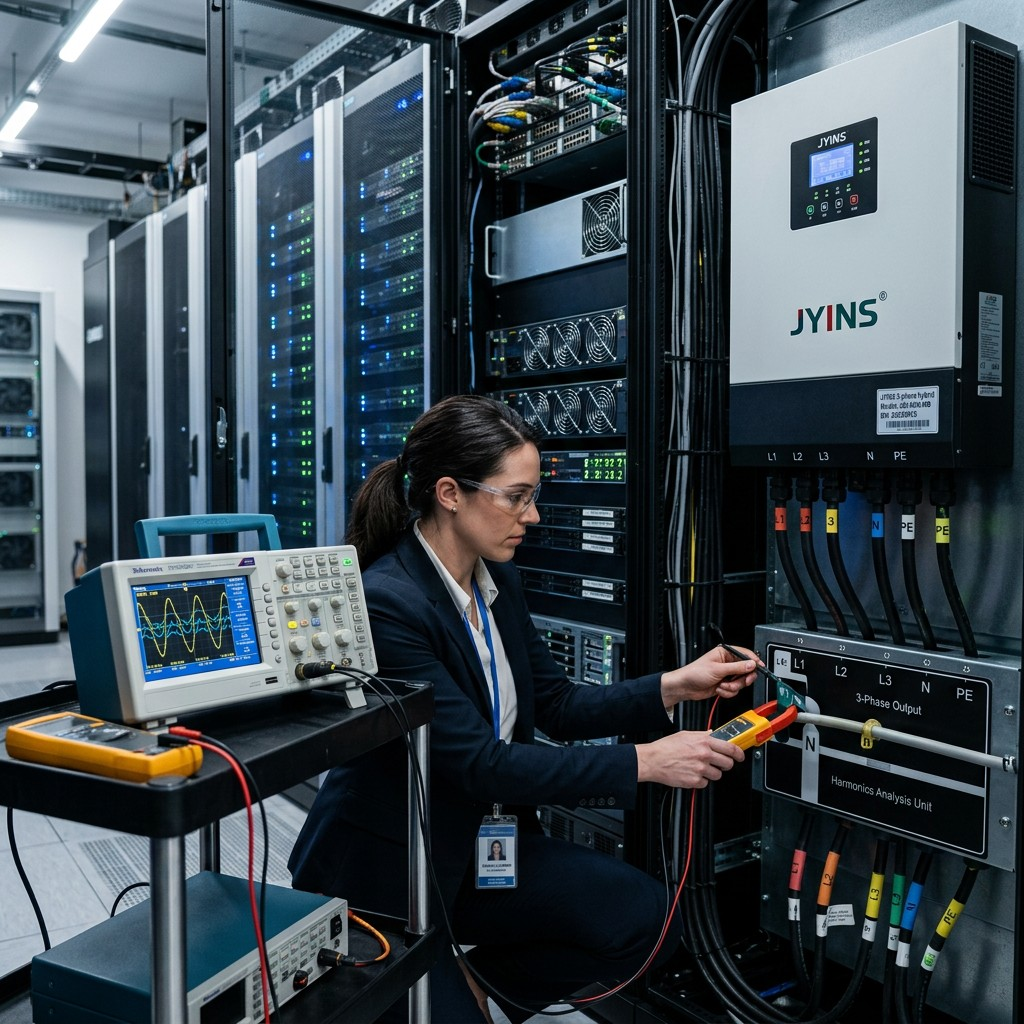
In modern B2B commercial buildings and large office parks, 3-phase hybrid inverter systems are increasingly widely deployed. However, as nonlinear office loads (servers, large numbers of PCs, LED lighting, and UPS equipment) surge, electrical engineers frequently encounter a thorny problem: the neutral (center-line) current rises abnormally, sometimes even exceeding the phase current. This not only causes cable overheating and insulation aging, but can also trigger frequent protective shutdowns of the inverter. The JYINS expert team provides a complete diagnostic and troubleshooting framework for this phenomenon, based on harmonic analysis and system design.
1. The Logical Conflict Between Nonlinear Office Loads and Neutral Current
In a traditional ideal 3-phase balanced system, if the loads are purely resistive and the phases are balanced, the vector sum of the currents on the neutral conductor should be zero. In modern office environments, however, the situation is very different:
- Characteristics of nonlinear loads: PC switched-mode power supplies (SMPS) and LED drivers do not draw current evenly across the entire voltage waveform; instead, they draw short pulses near the voltage peaks. This current waveform contains a large amount of harmonic content.
- The cumulative effect of triplen harmonics: In a 3-phase system, the 1st, 5th, and 7th harmonics tend to cancel out, or partially cancel out, on the neutral conductor. But zero-sequence harmonics such as the 3rd and its multiples (9th, 15th, etc.) coincide in time phase. This means that all of the 3rd-harmonic currents from the three phases add arithmetically on the neutral conductor, rather than cancelling vectorially.
- The result: Even when the three phase currents appear balanced, the neutral current can still reach 1.73 times the phase current or higher.
2. JYINS Hybrid Inverter System: Diagnostic and Identification Process
Before troubleshooting, the problem must be quantified with precise measurements. JYINS 3-phase hybrid inverters are equipped with a high-performance DSP (Digital Signal Processor) that monitors power quality parameters on each phase and on the neutral in real time.
- Step 1: Use a power quality analyzer or the inverter monitoring interface to check the THD (Total Harmonic Distortion). If the neutral current is abnormal and the current THD exceeds 30%, it can basically be confirmed that the 3rd harmonic is the culprit.
- Step 2: Measure the neutral-to-ground voltage. High neutral current is usually accompanied by a higher neutral-to-ground potential difference (N-G voltage); if it exceeds 2V, sensitive IT equipment may be disturbed.
- Step 3: Perform infrared thermography inspection. Check the temperature of the neutral cable and its termination points. The neutral conductor is often designed thinner than, or the same size as, the phase conductors and cannot handle the superimposed high current.
3. Troubleshooting Solutions Based on JYINS Technology
For B2B scenarios, we recommend interventions at two levels: physical architecture and inverter control.
- 1. Optimize Phase Load Balancing
Although harmonics are the root cause, fundamental-frequency unbalance further worsens the neutral burden. Engineers should re-review the distribution boards on each office floor to ensure PCs and lighting equipment are evenly distributed across L1, L2, and L3. The real-time current display on JYINS inverters helps technicians perform dynamic phase rebalancing under load.
- 2. Increase Neutral Conductor Ampacity
In new designs or retrofit projects where nonlinear loads account for more than 50% of the total load, we recommend increasing the neutral cable cross-section to 200% of the phase conductors. JYINS industrial-grade 3-phase inverters feature terminal designs with ample space to accommodate large-gauge neutral conductors, ensuring reliable connections in high-harmonic environments.
- 3. Deploy Active or Passive Harmonic Filters
For severe harmonic pollution, a triplen-harmonic filter (neutral current suppressor) can be installed on the distribution side. This device provides a low-impedance path for 3rd-harmonic currents so they circulate locally instead of returning to the inverter or the main transformer.
- 4. Leverage the Smart Harmonic Compensation of JYINS Inverters
Select JYINS high-end hybrid inverter models support power quality compensation at the point of common coupling. By adjusting the inverter bridge switching pattern through internal algorithms, reactive and harmonic currents generated by the loads can be offset to a certain degree, relieving pressure on the neutral conductor. In addition, make sure the inverter neutral grounding mode complies with local electrical codes (such as TN-S systems) to avoid ground-loop interference.
4. Preventive Measures and Long-Term Planning Recommendations
- Procure high-PF equipment: In office equipment tenders, prioritize power supplies with power factor (PF) greater than 0.98 and active power factor correction (APFC) to reduce harmonic generation at the source.
- Regular inspections and firmware upgrades: JYINS continuously updates the power management algorithms of its inverters. Make sure the equipment runs the latest firmware to obtain better dynamic response to complex nonlinear loads.
5. Summary
Dealing with high neutral current in 3-phase hybrid inverter systems is essentially a battle against harmonics. With JYINS precise monitoring, proper cable selection, and scientific harmonic management, businesses can not only eliminate fire hazards, but also significantly improve the operating efficiency of office electrical equipment. For commercial solar projects pursuing superior stability, deeply understanding and solving this technical detail is the key to project success.
Table of Contents
- Q: How to Troubleshoot High Neutral Current in 3-Phase Hybrid Inverter Systems Powering Heavy Nonlinear Office Loads?
- A:
- 1. The Logical Conflict Between Nonlinear Office Loads and Neutral Current
- 2. JYINS Hybrid Inverter System: Diagnostic and Identification Process
- 3. Troubleshooting Solutions Based on JYINS Technology
- 4. Preventive Measures and Long-Term Planning Recommendations
- 5. Summary