EN
EN


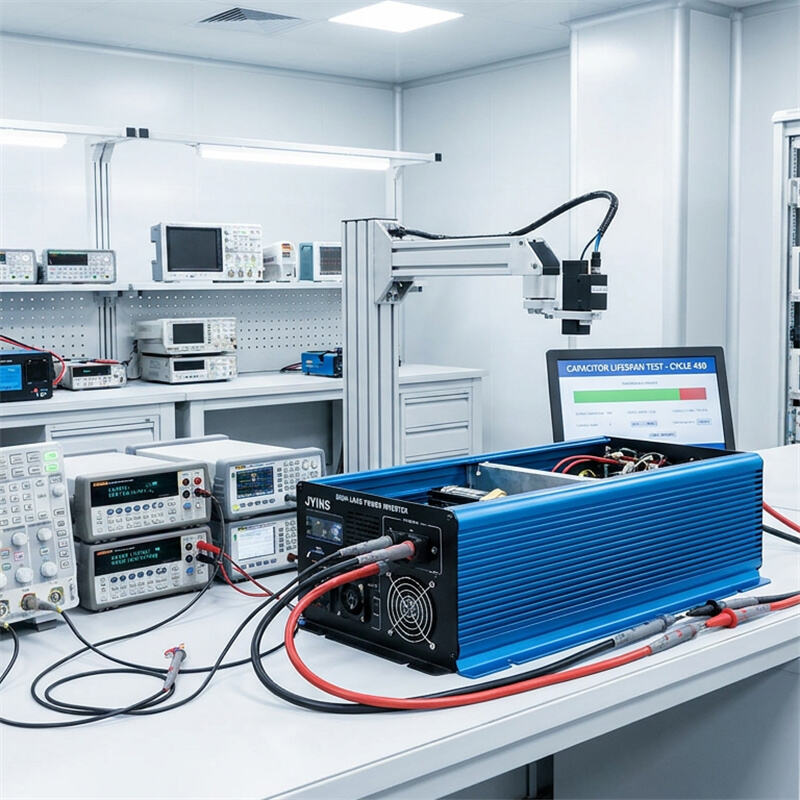
Introduction: Why Capacitor Lifespan Dictates Inverter Longevity
For B2B procurement directors and solar project wholesalers, selecting industrial-grade power inverters is an exercise in managing long-term operational risk. While marketing brochures often highlight peak efficiency rates and aesthetic housing design, the actual operational lifespan of an inverter is heavily dictated by its internal passive components. Among these components, the DC-link capacitor is arguably the most critical and the most vulnerable.
Capacitors in high-load inverters act as energy buffers, smoothing out voltage ripples and stabilizing the DC bus before inversion into AC. Under continuous, high-load industrial operations, these components are subjected to significant thermal stress and ripple currents. Because of their susceptibility to chemical degradation over time, capacitors are frequently the primary cause of premature inverter failures. This article provides a comprehensive framework for B2B procurement professionals to evaluate capacitor quality, predict degradation, and verify that their chosen inverter can reliably meet a ten year maintenance cycle without requiring costly mid-term field replacements.
Question: How can procurement directors accurately evaluate and predict the capacitor life of high-load inverters to ensure they meet a ten year maintenance cycle?
To answer this question, procurement teams must look beyond general data sheets and conduct a rigorous evaluation of component specifications, thermal design, and manufacturer testing standards. The following sections outline the precise steps, formulas, and technical benchmarks required to perform this assessment.
The Physics of Capacitor Degradation: The 10-Degree Celsius Rule
Most high-load inverters utilize aluminum electrolytic capacitors due to their high volumetric efficiency and cost-effectiveness. However, these capacitors contain a liquid electrolyte that gradually evaporates over time, leading to a rise in Equivalent Series Resistance (ESR) and a drop in overall capacitance. Once capacitance drops by more than twenty percent or ESR doubles, the capacitor is considered to have reached its end of life, which can trigger inverter shutdown or system failure.
This degradation process is highly sensitive to operating temperature and is governed by Arrhenius' Law. In the context of electrolytic capacitors, this is commonly referred to as the 10-Degree Celsius Rule. This rule states that for every ten-degree Celsius decrease in the capacitor's core operating temperature, its expected service life doubles. Conversely, a ten-degree increase halves its lifespan.
For example, if a capacitor is rated for two thousand hours at one hundred and five degrees Celsius, reducing its operating temperature to ninety-five degrees doubles its life to four thousand hours. Reducing it further to seventy-five degrees increases its lifespan to sixteen thousand hours. To predict a ten-year maintenance cycle (approximately eighty-seven thousand six hundred continuous hours), procurement managers must verify that the internal temperature of the capacitors remains well below their maximum thermal limits during standard operating conditions.
Critical Inverter Specifications to Vet During Procurement
When reviewing bids or technical files from potential inverter suppliers, procurement directors should systematically evaluate four key parameters related to capacitor design:
- Nominal Temperature Rating: Standard consumer-grade inverters often use capacitors rated for eighty-five degrees Celsius. For high-load B2B applications, you should insist on a minimum rating of one hundred and five degrees Celsius. This provides an essential thermal buffer that dramatically extends the capacitor's operational lifespan under continuous load.
- Sourcing and Brand Reputation: The quality of the electrolyte paste and sealing technology varies greatly among manufacturers. Premier Japanese brands such as Rubycon, Nippon Chemi-Con, and Nichicon are widely regarded as the gold standard for long-life industrial capacitors. Ensure that your inverter supplier utilizes these premium brands or certified industrial-grade equivalents rather than generic, low-cost alternatives.
- Ripple Current Rating: High ripple currents generate internal heat within the capacitor due to Joule heating (I-squared-R losses). Check the datasheet to ensure the capacitor's maximum rated ripple current is at least thirty percent higher than the maximum calculated ripple current of the inverter at full load.
- Physical Thermal Isolation: Examine the internal layout of the inverter. Capacitors should not be placed in close proximity to major heat-generating components such as IGBTs, power MOSFETs, or heat sinks. A well-designed inverter utilizes physical barriers or dedicated air channels to keep the capacitors isolated from high-temperature zones.
Predictive Mathematical Modeling for B2B Wholesalers
How do we translate these variables into a concrete mathematical prediction for a ten-year maintenance cycle? Professional manufacturers like JYINS Electrical utilize the following standard lifetime estimation model for electrolytic capacitors:
L = L-zero (V-ratio) 2 raised to the power of ((T-max minus T-actual) divided by ten)
In this predictive formula:
- L is the estimated operating lifetime in hours.
- L-zero is the base lifetime of the capacitor at its maximum rated temperature (e.g., five thousand hours at one hundred and five degrees Celsius).
- V-ratio is a multiplier representing the voltage derating factor, typically around one to one point five depending on the applied voltage relative to the rated voltage.
- T-max is the maximum rated temperature of the capacitor (one hundred and five degrees Celsius).
- T-actual is the actual core temperature of the capacitor under real-world operating conditions.
To achieve a ten-year maintenance cycle (eighty-seven thousand six hundred hours) with a base capacitor rated for five thousand hours at one hundred and five degrees Celsius, the actual core temperature of the capacitor must not exceed sixty-five degrees Celsius during operation. Procurement directors should demand thermal test reports from the supplier showing the actual temperature of the DC-link capacitors during continuous full-load testing at an ambient temperature of forty degrees Celsius.
How JYINS Electrical Optimizes Capacitor Life
At JYINS Electrical, we design our power inverters with an uncompromising focus on long-term reliability. We address capacitor degradation through advanced engineering and strict component sourcing:
- Premium Sourcing: We exclusively use high-temperature, industrial-grade capacitors from top-tier manufacturers, ensuring superior seal integrity and electrolyte stability.
- Smart Thermal Management: Our inverters feature active thermal separation. By isolating the DC-link capacitors in a separate, cooler compartment of the aluminum housing and utilizing high-velocity cooling paths, we ensure that capacitor core temperatures remain exceptionally low.
- Voltage and Current Derating: We design our circuits with conservative margins. Our capacitors are typically operated at no more than seventy percent of their rated voltage and sixty percent of their rated ripple current, further extending their service life.
Conclusion: The B2B Procurement Checklist for Capacitor Life
To secure a hassle-free ten-year maintenance cycle for your power inverter fleet, ensure your procurement checklist includes the following steps:
1. Request the internal bill of materials (BOM) to verify the brand, model, and temperature rating of the DC-link capacitors.
2. Demand the inverter's thermal imaging reports and full-load temperature test data to confirm capacitor core temperatures do not exceed sixty-five degrees Celsius at standard operating conditions.
3. Confirm that the supplier designs with a voltage derating factor of at least twenty to thirty percent.
By conducting this rigorous due diligence, B2B buyers can confidently procure high-load inverters that will stand the test of time, reducing total cost of ownership and ensuring uninterrupted power for critical industrial applications.
Table of Contents
- Introduction: Why Capacitor Lifespan Dictates Inverter Longevity
- Question: How can procurement directors accurately evaluate and predict the capacitor life of high-load inverters to ensure they meet a ten year maintenance cycle?
- The Physics of Capacitor Degradation: The 10-Degree Celsius Rule
- Critical Inverter Specifications to Vet During Procurement
- Predictive Mathematical Modeling for B2B Wholesalers
- How JYINS Electrical Optimizes Capacitor Life
- Conclusion: The B2B Procurement Checklist for Capacitor Life