EN


IGBT Voltage Stabilizer: What It Is, How It Works, and How to Size One
An IGBT voltage stabilizer is a static automatic voltage regulator that rebuilds the output sine wave through AC–DC–AC conversion instead of switching transformer taps. It holds voltage-sensitive equipment at a steady output while the supply swings across a wide input window. This guide covers what the device is, how it works, how it compares with servo and relay stabilizers, and how to size one.
What Is an IGBT Voltage Stabilizer?
An IGBT voltage stabilizer regulates output voltage using insulated gate bipolar transistors as its switching element. Incoming AC is rectified to a DC link and then re-generated as a clean sine wave at the target voltage, so correction is continuous rather than stepwise — no brush travel, no tap switching, and no switching transient reaching the load.
Suppliers also list it as an inverter-type stabilizer, a static AVR, or an electronic AVR — the labels differ, the double-conversion principle does not.
Typical performance band
- Correction: continuous and stepless, with response in the 10–20 ms range on IGBT platforms
- Efficiency: roughly 96% or better, since there is no copper-coil transformer to regulate through
- Output: pure sine wave, without the step transients of tap changers
- Moving parts: none in the regulation path — fans are the only wearing items
How Does an IGBT Voltage Stabilizer Work?
It converts, then rebuilds. The input stage rectifies AC into DC; a capacitor bank holds the DC link steady and absorbs short disturbances; an IGBT bridge switches at high frequency to rebuild a pure sine wave at the set voltage, driven by a DSP or MCU controller reading voltage and current feedback. An output filter strips the switching ripple, with EMI and surge protection at both ends.
Key components
- Rectifier and DC-link capacitor bank
- IGBT bridge module and gate driver
- DSP or MCU control board with voltage/current sensing
- Output filter, EMI filter, surge protection
- Forced-air cooling and thermal management
The same building blocks appear across our power-electronics boards, which use devices from Infineon, Texas Instruments, ON Semiconductor, NXP, Littelfuse and Vishay.
IGBT vs Servo vs Relay: Which Fits Your Load?
IGBT corrects continuously for sensitive loads; servo trades speed for capacity range; relay is the low-cost option for tolerant loads.
| Dimension | IGBT (static) | Servo motor | Relay |
|---|---|---|---|
| Regulation method | AC–DC–AC, continuous | Motor-driven brush | Step tap switching |
| Correction speed | Continuous, 10–20 ms | 0.5–3 s, mechanical | Discrete steps, ≥100 ms |
| Output waveform | Regenerated sine wave | Slight distortion possible | Jitter at each tap shift |
| Moving parts | None | Brushes and motor | Relay contacts |
| Maintenance | Fans and filters only | Brush replacement | Contact wear |
| Best for | Sensitive, critical loads | Large panels, tolerant loads | Cost-sensitive light loads |
Servo units still win on large panels with tolerant loads and tight budgets, because they cost less per kVA at high capacity. IGBT becomes cheaper once a single voltage event can stop a line or corrupt a test run.
What It Can and Cannot Do
It can hold output voltage, ride through deep sags, and keep the waveform clean enough for motors, pumps and inverter loads.
It cannot store energy: in a full outage the output is zero, because a stabilizer conditions voltage while a UPS supplies backup power. If your process cannot tolerate a power cut, specify both. Nor does it clean harmonics generated downstream — that is the job of an active harmonic filter.
How to Size an IGBT Voltage Stabilizer
Size from measured running load, add a surge and expansion margin, then confirm the input window before choosing a rating.
Required kVA = (total running kW ÷ load power factor) × (1 + margin)
A 40 kW load at 0.8 PF needs 50 kVA before margin; 20% margin takes it to 60 kVA.
Four variables that change the answer
- Phase configuration: single-phase for homes and small commercial loads, three-phase for industrial panels.
- Input range: measure the lowest and highest site voltage, not nominal.
- Low-input derating: capacity can fall near the bottom of the window; ask for the derating curve.
- Motor surge: use nameplate locked-rotor current, not a rule-of-thumb multiplier.
Where IGBT Stabilizers Are Used
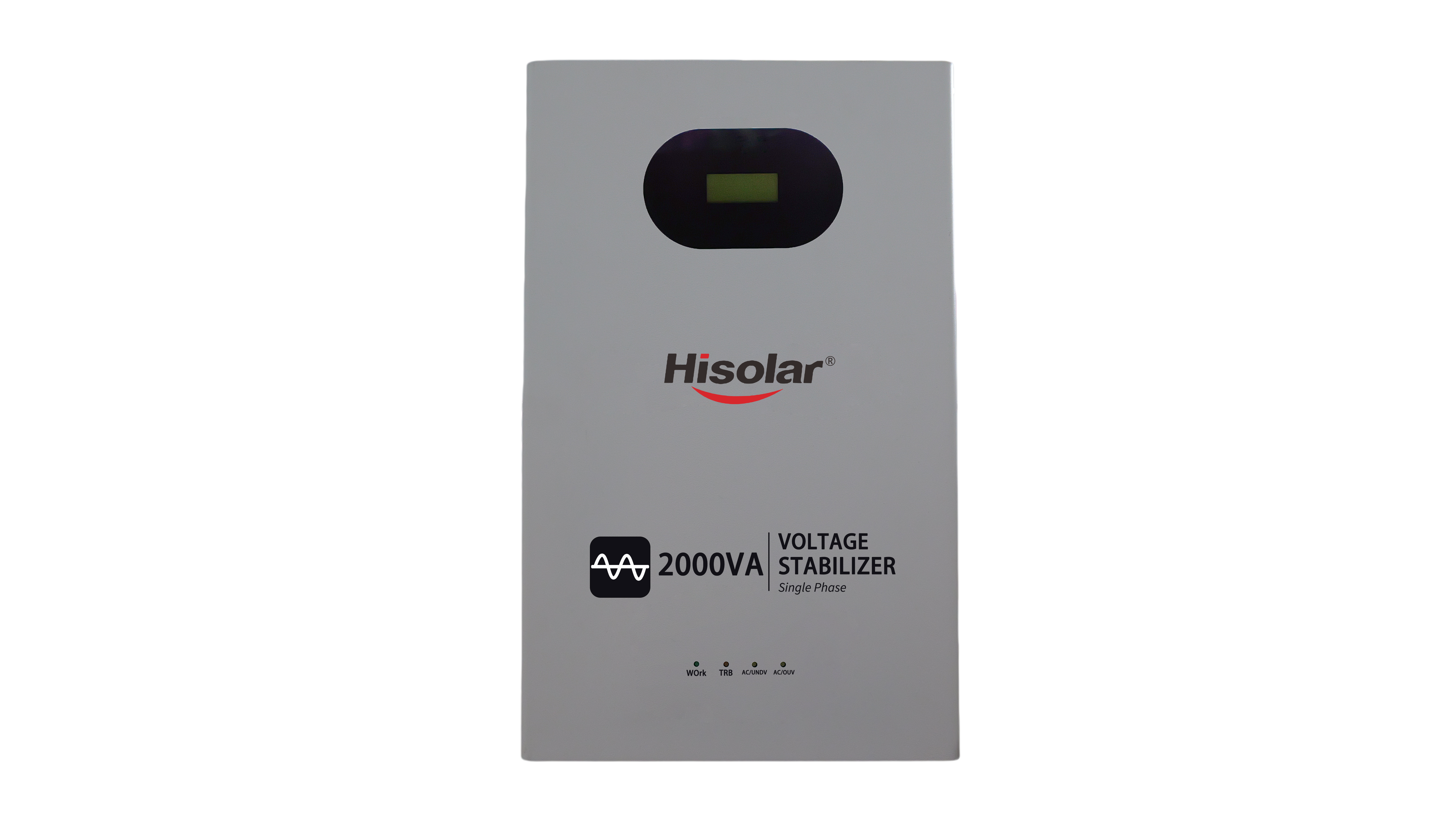
Stabilizers of this class are specified for residential and commercial buildings, industrial workshops, laser equipment and CNC machine tools, hospital and laboratory instruments, data rooms and communication base stations, construction sites, and rural networks with unstable voltage. Our current voltage stabilizer range covers single-phase loads from 600 VA to 10 kVA.
For three-phase industrial sites, voltage support moves up a level: IGBT-based static var generators compensate reactive power, and active harmonic filters remove distortion a stabilizer cannot.
Why Buy From JYINS
Zhejiang Jyins Electrical Co., Ltd. (JYINS, brand Hisolar) has built electrical equipment in Wenzhou, Zhejiang since 1993 — more than 30 years. The group employs over 150 people, including 8 senior engineers, and runs a provincial-level technology centre with a 12-person R&D team averaging 15+ years of experience. Products ship to 50+ countries.
- Stabilizer range: JYVS series 600 VA–10 kVA, 90–310 V input, 230 V output, 43–57 Hz, with over-voltage, under-voltage, overload, over-temperature (80 °C) and short-circuit protection
- Power quality: IGBT-based SVG from 50 to 500 kVar and AHF cabinets for 200–800 V systems
- Certification: ISO 9001, ISO 14001, ISO 45001, CE, SAA, RoHS, FCC
- Supply terms: OEM/ODM with flexible MOQ, samples in 7–10 days, standard products in 10 days
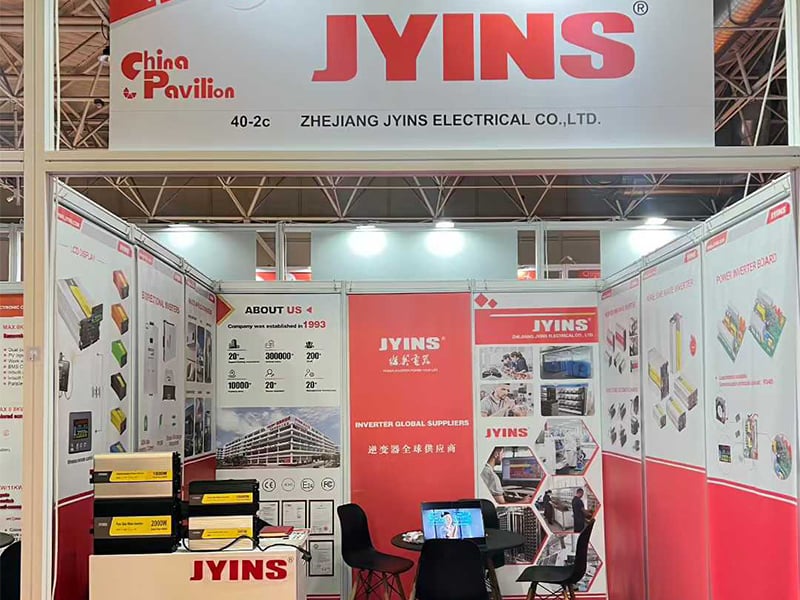
- Industry standing: participant in national standard drafting for household mobile energy storage power sources, and exhibitor at Vietnam Hardware Fair and Iran International Electricity Exhibition
Send your load list, input voltage range, phase configuration and destination market, and our engineers will size the unit before you commit.
FAQ
What is an IGBT voltage stabilizer?
An IGBT voltage stabilizer is a static regulator that converts incoming AC to DC and rebuilds a clean sine wave at a stable output voltage. It corrects continuously rather than in steps, so sensitive equipment sees no tap-shift transients or supply waveform distortion.
How do I calculate the kVA rating I need?
Divide total running kilowatts by the load power factor, then add a margin for starting surge and future expansion. A 40 kW load at 0.8 PF needs 50 kVA before margin. Check the lowest site input voltage, because capacity can derate near the bottom of the window.
What is the difference between an IGBT and a servo stabilizer?
An IGBT stabilizer corrects continuously with no moving parts and regenerates the output waveform. A servo stabilizer corrects mechanically through a motor and brush, which is slower and needs periodic service, but remains cost-effective for large panels with tolerant loads.
Do I still need a UPS if I use an IGBT stabilizer?
Yes, if outages matter. A stabilizer regulates voltage but stores no energy, so output falls to zero during a complete power cut. Voltage conditioning and battery backup solve different problems; critical loads usually need both.
Why does my stabilizer keep tripping?
Most trips trace to overload, input voltage outside the specified range, blocked ventilation, or phase imbalance on three-phase units. Check measured input, per-phase current and airflow before concluding the unit itself has failed.
Table of Contents
- IGBT Voltage Stabilizer: What It Is, How It Works, and How to Size One
- What Is an IGBT Voltage Stabilizer?
- How Does an IGBT Voltage Stabilizer Work?
- IGBT vs Servo vs Relay: Which Fits Your Load?
- What It Can and Cannot Do
- How to Size an IGBT Voltage Stabilizer
- Where IGBT Stabilizers Are Used
- Why Buy From JYINS
- FAQ